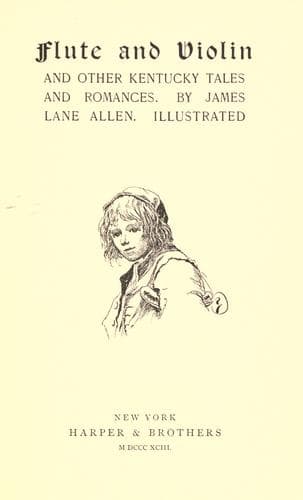
Flute and Violin, and Other Kentucky Tales and RomancesAllen, James Lane
General
Flute and Violin, and Other Kentucky Tales and Romances
Allen, James Lane
Kentucky -- Social life and customs -- Fiction; Short stories, American
Even the next day, when he had been wounded and life was rapidly
flowing from him, and earthly ties seemed soon to be snapped, he had
thought only of this tie, new and sacred, and had written to her. Poor
boy!--he had written, as with his heart's blood, his brief, pathetic
appeal that she would come and be united to him before he died. In all
ages of the world there have been persons, simple in nature and simple
in their faith in another life, who have forgotten everything else in
the last hour but the supreme wish to grapple to them those they love,
for eternity, and at whatever cost. Such simplicity of nature and faith
belonged to him; for although in Kentucky the unrest of the century
touching belief in the supernatural, and the many phases by which this
expresses itself, are not, unknown, they had never affected him. He
believed as his fathers had believed, that to be united in this world
in any relation is to be united in that relation, mysteriously changed
yet mysteriously the same, in another.
But this letter had never been sent. There had been no one to take it
at the time; and when Ezra returned with the physician he had fainted
away from loss of blood.
Then had followed the dressing of the wound, days of fever and
unconsciousness, and then the assurance that he would get well. Thus,
nearly a month had passed, and for him a great change had come over
the face of nature and the light of the world. With that preternatural
calm of mind which only an invalid or a passionless philosopher ever
obtains, he now looked back upon an episode which thus acquired
fictitious remoteness. So weak that he could scarcely lift his head
from his pillow, there left his heart the keen, joyous sense of human
ties and pursuits. He lost the key to the motives and forces of his
own character. But it is often the natural result of such illness that
while the springs of feeling seem to dry up, the conscience remains
sensitive, or even burns more brightly, as a star through a rarer
atmosphere. So that, lying thus in the poor farm-house during dreary
days, with his life half-gone out of him and with only the sad image
of her always before his eyes, he could think of nothing but his cruel
folly in having broken in upon her peace; for perfect peace of some
sort she must have had in comparison with what was now left her.
Beneath his pillow he kept her letter, and as he often read it over he
asked himself how he could ever have hoped to change the conscience
which had inspired such a letter as that. If her heart belonged to him,
did not her soul belong to her religion; and if one or the other must
give way, could it be doubtful with such a nature as hers which would
come out victorious? Thus he said to himself that any further attempt
to see her could but result in greater suffering to them both, and that
nothing was left him but what she herself had urged--to go away and
resign her to a life, from which he had too late found out that she
could never be divorced.
Public-domain text, read in full here on John Shaqi.
Reviews
Reviews
No reviews yet
Be the first to share your thoughts on this work.
Elsewhere in the archive
Join the Discussion
Join the discussion
Sign in to leave a comment or review.
Sign InorCreate an account