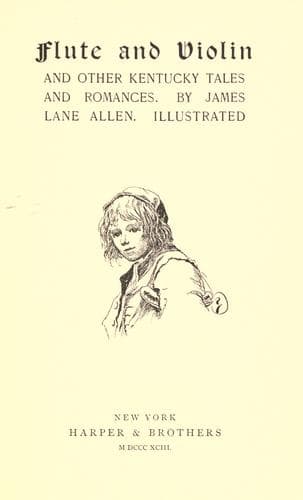
Flute and Violin, and Other Kentucky Tales and RomancesAllen, James Lane
General
Flute and Violin, and Other Kentucky Tales and Romances
Allen, James Lane
Kentucky -- Social life and customs -- Fiction; Short stories, American
POSTHUMOUS FAME; OR, A LEGEND OF THE BEAUTIFUL.
I.
There once lived in a great city, where the dead were all but
innumerable, a young man by the name of Nicholas Vane, who possessed a
singular genius for the making of tombstones. So beautiful they were,
and so fitly designed to express the shadowy pain of mortal memory or
the bright forecasting of eternal hope, that all persons were held
fortunate who could secure them for the calm resting-places of their
beloved sleepers. Indeed, the curious tale was whispered round that
the bereft were not his only patrons, but that certain personages who
were peculiarly ambitious of posthumous fame--seeing they had not long
to live, and unwilling to intrust others with the grave responsibility
of having them commemorated--had gone to his shop and secretly advised
with him respecting such monuments as might preserve their memories
from too swift oblivion.
However this may fall out, certain it is that his calling had its
secrets; and once he was known to observe that no man could ever
understand the human heart until he had become a maker of tombstones.
Whether the knowledge thus derived should make of one a laughing or
a weeping philosopher, Nicholas himself remained a joyous type of
youthful manhood--so joyous, in fact, that a friend of his who wrought
in color, strolling one day into the workshop where Nicholas stood
surrounded by the exquisite shapes of memorial marbles, had asked to
paint the scene as a representation of Life chiselling to its beautiful
purposes the rugged symbols of Death, and smiling as it wove the words
of love and faith across the stony proofs of the universal tragedy.
Afterwards, it is true, a great change was wrought in the young artisan.
He had just come in one morning and paused to look around at the
various finished and unfinished mortuary designs.
"Truly," he said to himself all at once, "if I were a wise man, I'd
begin this day's business by chiselling my own head-stone. For who
knows but that before sunset my brother the grave-digger may be told
to build me one of the houses that last till doomsday! And what man
could then make the monument to stop the door of _my_ house with? But
why should I have a monument? If I lie beneath it, I shall not know
I lie there. If I lie not there, then it will not stand over me. So,
whether I lie there, or lie not there, what will it matter to me then?
Aye; but what if, being dead only to this world and living in another,
I should yet look on the monument erected to my memory and therefore
be the happier? I know not; nor to what end we are vexed with this
desire to be remembered after death. The prospect of vanishing from
a poor, toilsome life fills us with such consternation and pain! It
is therefore we strive to impress ourselves ineffaceably on the race,
so that, after we have gone hence, or ceased to be, we may still have
incorporeal habitation among all coming generations."
Public-domain text, read in full here on John Shaqi.
Reviews
Reviews
No reviews yet
Be the first to share your thoughts on this work.
Elsewhere in the archive
Join the Discussion
Join the discussion
Sign in to leave a comment or review.
Sign InorCreate an account