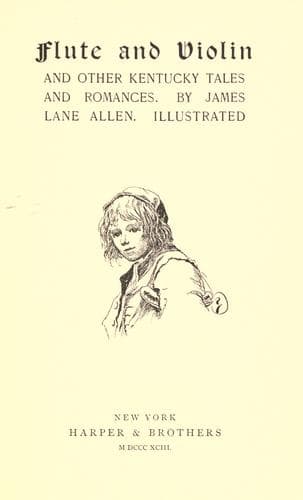
Flute and Violin, and Other Kentucky Tales and RomancesAllen, James Lane
General
Flute and Violin, and Other Kentucky Tales and Romances
Allen, James Lane
Kentucky -- Social life and customs -- Fiction; Short stories, American
Mysterious complexity of our mortal nature and estate that we should
so desire to be remembered after death, though born to be forgotten!
Our words and deeds, the influences of our silent personalities, do
indeed pass from us into the long history of the race and abide for
the rest of time: so that an earthly immortality is the heritage, nay,
the inalienable necessity, of even the commonest lives; only it is an
immortality not of self, but of its good and evil. For Nature sows
us and reaps us, that she may gather a harvest, not of us, but from
us. It is God alone that gathers the harvest of us. And well for us
that our destiny should be that general forgetfulness we so strangely
shrink from. For no sooner are we gone hence than, even for such brief
times as our memories may endure, we are apt to grow by processes
of accumulative transformation into what we never were. Thou kind,
kind fate, therefore--never enough named and celebrated--that biddest
the sun of memory rise on our finished but imperfect lives, and then
lengthenest or shortenest the little day of posthumous reminiscence,
according as thou seest there is need of early twilight or of deeper
shadows!
* * * * *
Years passed. City and cemetery were each grown vaster. It was again
an afternoon when the people strolled among the graves and monuments.
An old man had courteously attached himself to a group that stood
around a crumbling memorial. He had reached a great age; but his figure
was erect, his face animated by strong emotions, and his eyes burned
beneath his brows.
"Sirs," said he, interposing in the conversation, which turned wholly
on the monument, "you say nothing of him in whose honor it was erected."
"We say nothing because we know nothing."
"Is he then wholly forgotten?"
"We are not aware that he is at all remembered."
"The inscription reads: 'He was a poet.' Know you none of his poems?"
"We have never so much as heard of his poems."
"My eyes are dim; is there nothing carved beneath his name?"
One of the by-standers went up and knelt down close to the base.
"There _was_ something here, but it is effaced by time--Wait!" And
tracing his finger slowly along, he read like a child:
"He--asked--but--for--the--common--lot.
"That is all," he cried, springing lightly up. "Oh, the dust on my
knees!" he added with vexation.
"He may have sung very sweetly," pursued the old man.
"He may, indeed!" they answered, carelessly.
"But, sirs," continued he, with a sad smile, "perhaps you are the very
generation that he looked to for the fame which his own denied him;
perhaps he died believing that _you_ would fully appreciate his poems."
"If so, it was a comfortable faith to die in," they said, laughing, in
return. "He will never know that we did not. A few great poets have
posthumous fame: we know _them_ well enough." And they passed on.
Public-domain text, read in full here on John Shaqi.
Reviews
Reviews
No reviews yet
Be the first to share your thoughts on this work.
Elsewhere in the archive
Join the Discussion
Join the discussion
Sign in to leave a comment or review.
Sign InorCreate an account