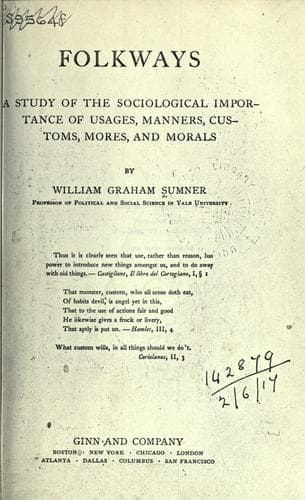
Folkways: A Study of the Sociological Importance of Usages, Manners, Customs, Mores, and MoralsSumner, William Graham
General
Folkways: A Study of the Sociological Importance of Usages, Manners, Customs, Mores, and Morals
Sumner, William Graham
Manners and customs
+150. Plutocratic effects of money.+ It must not be understood that the
money, on the barbaric stage, enters into the struggle for existence, at
least for food. There is only slight organization of labor. Each one
produces what he needs. There is little luxury. "Nevertheless, money
plays the chief role in the life of the people. The man, regarded as an
animal, has enough to do to support life. If he wants a wife, wants to
found a family, wants to be a member of the state, he must have
money."[325] It is evident that the circulation of this money must
produce phenomena which are unfamiliar to us.
The estimate placed by the Solomon Islanders on great stones of
aragonite, obtained in the southern Palau islands, is such that
they incur great risks in going to get them in their frail
boats.[326] The pieces have the appearance of our own
grindstones. They are set in rows by the men's clubhouses, and
are in care of the chiefs. Christian mentions two of the Big
Houses on Yap with stone money piled against the foundations. One
piece was twelve feet in diameter and one and a half feet thick,
and had a hole in the center two and a half feet in
diameter.[327] A certain Captain O'Keefe, in 1882, fitted out a
Chinese vessel and brought thousands of pieces of money from
Palau to Yap. He brought the whole island in debt to himself.
Nowadays they want big stones. Such six feet in diameter are not
rare. This kind of money is the money of the men; that of the
women is of mussel shells strung on strings. The exchange of a
big piece for smaller kinds of money involves considerations of
rank. Two of equal rank, and well disposed, exchange by dignity;
if one is inferior, the good will of the other is requisite. The
glass and porcelain money on Yap must have come from China or
Japan. It has controlled the social development of the islands.
It is also noticeable that other things of high utility, e.g. the
wooden vessels in which yellow powder is prepared, or in which
food is set forth at feasts, are made the objects of exchange,
and, at the making of peace after a fight, or at other
negotiations, affect the relations of tribes.[328] At the present
time bags of dried cocoanut are employed as a medium of exchange,
probably in intergroup trade.[329] What Kubary[330] says about
the use of the money shows that it has no proper circulation. It
accumulates in the hands of the great men, since it is used to
pay fees, fines, gifts, tribute, etc. The armengol women,
marriages, and public festivals start it out again, and on its
way back it performs many social services. It is also reasonable
to suppose that, having got a footing on these islands, it spread
to others by social contagion. This explains the presence of a
general medium of exchange amongst people who are otherwise
barely out of the stone age.[331] The tales about the crimes
Public-domain text, read in full here on John Shaqi.
Reviews
Reviews
No reviews yet
Be the first to share your thoughts on this work.
Elsewhere in the archive
Join the Discussion
Join the discussion
Sign in to leave a comment or review.
Sign InorCreate an account