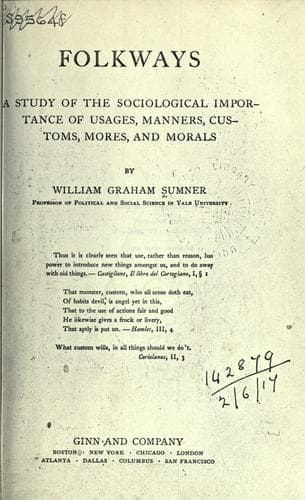
Folkways: A Study of the Sociological Importance of Usages, Manners, Customs, Mores, and MoralsSumner, William Graham
General
Folkways: A Study of the Sociological Importance of Usages, Manners, Customs, Mores, and Morals
Sumner, William Graham
Manners and customs
[353] Deut. xiv. 24.
[354] Levit. xxvii. 13, 15, 19.
[355] Buhl, _Soc. Verhaelt. der Isr._, 95.
[356] Ridgeway, _Origin of Currency and Weight Standards_, 36.
[357] Ridgeway, 3.
[358] Schurz, 15.
[359] Babelon, _Origines de la Monnaie_, 72.
[360] Schrader, _Prehist. Antiq. of Aryans_, 153; Ridgeway, 31.
[361] Weinhold, _D. F._, II, 52.
[362] Geijer, _Sveriges Historie_, I, 327; Sophus Mueller, _Vor
Oldtid_, 409.
[363] See Chapter VI.
[364] Sophokles, _Antigone_, 292 (Campbell's trans.).
[365] JAI, XXVI, 405.
CHAPTER IV
LABOR, WEALTH
Introduction.--Notions of labor.--Classical and mediaeval
notions.--Labor has always existed.--Modern view of labor.--
Movable capital in modern society; conditions of equality;
present temporary status of the demand for men.--Effect of the
facility of winning wealth.--Chances of acquiring wealth in
modern times; effect on modern mores; speculation involved in any
change.--Mores conform to changes in life conditions; great
principles; their value and fate.--The French revolution.--
Ruling classes; special privileges; corruption of the mores.--
The standard of living.
+157.+ The topics treated in Chapter III--tools, language, and
money--belong almost entirely in the folkways. The element of esteem for
tools is sometimes very great. They are made divine and receive worship.
Nevertheless, there is little reflection stimulated to produce a sense
of their importance to welfare. Therefore the moral element pertaining
to the mores is not prominent in them. When the moral element exists at
all in regard to tools, language, or money, it is independent and rises
to the conception of prosperity, its sense and conditions. There are
notions at all stages of civilization about productive labor and wealth,
as parts of the fate of man on earth and of the conditions of his
happiness and welfare. At this point they take the character of a
philosophy, and are turned back on the work, as regulative notions of
how, and how much, to work. The mores of the struggle for existence are
in those notions. From the time when men had any accumulated wealth they
seem to have been struck by its effect on the character of the
possessor. The creature seemed to be stronger than the creator. Here
ethical reflections began. They have been more actively produced since
it has been possible for men to acquire wealth in a lifetime by their
own efforts. Envy has been awakened, and has been gratified by
theoretical discussions of the power, rights, and duties of wealth. When
wealth was due to the possession of land or to the possession of rank
and political power, the facts about its distribution seemed to be like
the differences in health, strength, beauty, etc. It now appears that
the ethics of poverty are as well worth studying as those of wealth, and
Public-domain text, read in full here on John Shaqi.
Reviews
Reviews
No reviews yet
Be the first to share your thoughts on this work.
Elsewhere in the archive
Join the Discussion
Join the discussion
Sign in to leave a comment or review.
Sign InorCreate an account