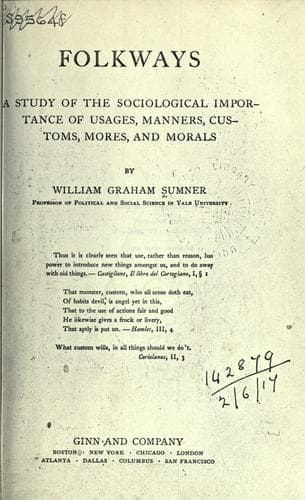
Folkways: A Study of the Sociological Importance of Usages, Manners, Customs, Mores, and MoralsSumner, William Graham
General
Folkways: A Study of the Sociological Importance of Usages, Manners, Customs, Mores, and Morals
Sumner, William Graham
Manners and customs
+159. Classical and mediaeval notions of labor.+ The Greeks and Romans
regarded all labor for gain as degrading. The Greeks seem to have
reached this opinion through a great esteem for intellectual pursuits,
which they thought means of cultivation. The gainful occupations, or any
occupations pursued for gain, were "banausic," which meant that they had
an effect opposite to that of cultivation. The Romans seem to have
adopted the Greek view, but they were prepared for it by militarism. The
Middle Ages got the notion of labor from the Roman tradition. They mixed
this with the biblical view. Labor was a necessity, as a consequence and
penalty of sin, and directly connected, as a curse, with the "Fall." It
was correlative to a curse on the ground, by which, also as a curse for
sin, it was made hard to win subsistence by agriculture. The mediaeval
philosophers, being clerics, held a life of contemplation to be far
superior to one of labor or fighting. Labor was at best an evil
necessity, a hardship, a symptom of the case of man, alienated from God
and toiling to get back, if there was a way to get back, to the kingdom
of God. The church offered a way to get back, namely, by sacraments,
devotion, ritual, etc., that is, by a technically religious life, which
could be lived successfully only if practiced exclusively. It occupied
all the time of the "religious," technically so called. Labor was used
for penance and for ascetic purposes. Often it was employed for useful
results and with beneficial effect on useful arts. The purpose, however,
was to ward off the vices of leisure. The ascetic temper and taste made
labor sweet, so long as asceticism ruled the mores of the age.[368]
Labor for economic production was not appreciated by the church. The
production of wealth was not a religious purpose. It was even
discouraged, since disapproval of wealth and luxury was one of the deep
controlling principles of mediaeval Christianity. The unreality of
mediaeval world philosophy appeared most distinctly in the views of
marriage and labor, the two chief interests of everyday life. Marriage
was a concession, a compromise with human weakness. There was something
better, viz. celibacy. Labor was a base necessity. Contemplation was
better.
Public-domain text, read in full here on John Shaqi.
Reviews
Reviews
No reviews yet
Be the first to share your thoughts on this work.
Elsewhere in the archive
Join the Discussion
Join the discussion
Sign in to leave a comment or review.
Sign InorCreate an account