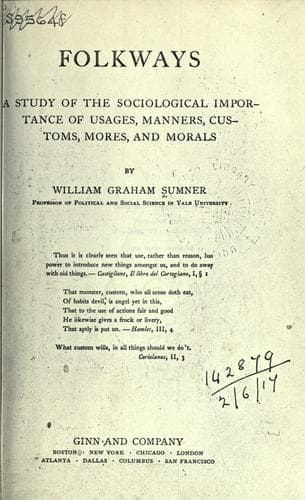
Folkways: A Study of the Sociological Importance of Usages, Manners, Customs, Mores, and MoralsSumner, William Graham
General
Folkways: A Study of the Sociological Importance of Usages, Manners, Customs, Mores, and Morals
Sumner, William Graham
Manners and customs
+203. Ideals.+ An ideal is entirely unscientific. It is a phantasm which
has little or no connection with fact. Ideals are very often formed in
the effort to escape from the hard task of dealing with facts, which is
the function of science and art. There is no process by which to reach
an ideal. There are no tests by which to verify it. It is therefore
impossible to frame a proposition about an ideal which can be proved or
disproved. It follows that the use of ideals is to be strictly limited
to proper cases, and that the attempt to use ideals in social discussion
does not deserve serious consideration. An ideal differs from a model in
that the model is deduced from reality but within the bounds of reality.
It is subject to approved methods of attainment and realization. An
ideal also differs from a standard, for a standard must be real.
+204. When ideals may be used.+ What are the proper cases for the use of
ideals? Ideals can be useful when they are formed in the imagination of
the person who is to realize them by his own exertions, for then the
ideal and the programme of action are in the same consciousness, and
therefore the defects of an ideal are reduced or removed. Ideals are
useful (_a_) in homiletics, which are chiefly occupied with attempts at
suggestion. In limited cases a preacher or teacher can suggest ideals
which, if apprehended and adopted, become types toward which young
persons may train themselves. Even then these cases merge in the next
class. (_b_) Ideals are useful in self-education. The idea is then taken
up from books or from admired persons by suggestion and imitation, or
from autosuggestion, but generally from a combination of the two. An
ideal from autosuggestion produces enthusiasm. The fantastic character
of the ideal, if the person is young, is unimportant. His will is
enlisted to work for it. He can constantly compare the ideal with his
experience. The ideal is at last shorn down to reality and merges in
sober plans of effort. (_c_) A far larger field for ideals is afforded
by vanity. As vanity is itself a subjective affection, but one which can
be awakened only in society, it uses the imagination to suppose cases,
plan unlimited schemes, devise types of self-decoration and dreams of
superiority, distinction, power, success, and glory. The creations are
all phantasms. The ends are all ideals. These ideals may not be
extravagant. Vanity generally creates them by raising to a higher pitch
some treatment of the body or dress, some admired trait of character,
some action which has won glory, or given pleasure and won applause.
This whole field for ideals is largely influenced by suggestion from the
current tastes and fashionable standards in the group, but
autosuggestion is also very active in it. (_d_) Ideals also find a great
field in marriage. In this case ideals of happiness have powerfully
affected the institution at all its stages. Experience of marriage has
been partly pleasant and partly the contrary.
Public-domain text, read in full here on John Shaqi.
Reviews
Reviews
No reviews yet
Be the first to share your thoughts on this work.
Elsewhere in the archive
Join the Discussion
Join the discussion
Sign in to leave a comment or review.
Sign InorCreate an account