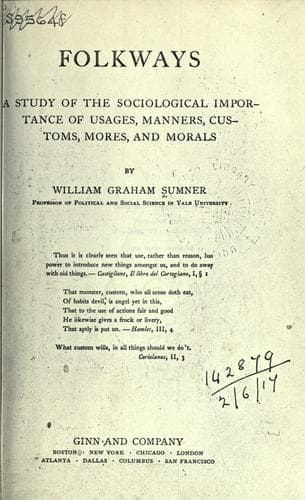
Folkways: A Study of the Sociological Importance of Usages, Manners, Customs, Mores, and MoralsSumner, William Graham
General
Folkways: A Study of the Sociological Importance of Usages, Manners, Customs, Mores, and Morals
Sumner, William Graham
Manners and customs
+224. The mediaeval church operated societal selection.+ It is evident
that the mediaeval church was a machine to exert societal selection. The
great reason for its strength as such is that it never made the mores of
the age; it proceeded out of them. It contributed, through a thousand
previous years, phantasms about the other world and dogmas about the
relation of this world to that one. These dogmas became mixed with all
the experience of life in the days of civic decline and misery, and
produced the mores of the tenth and eleventh centuries. All the great
doctrines then took on the form of manias or delusions. In the early
centuries of the Christian era "catholic" meant Christendom in its
entirety, in contrast with the separate congregations, so that the
concepts "all congregations" and the "universal church" are identical.
However, the church over the whole world was thought to have been
founded by the apostles, so that that only could be true which was found
everywhere in Christendom. So "catholic" came to have a pregnant
meaning, and got dogmatic and political connotations.[471] In the
eleventh century all Christendom was reduced to civic fragments in which
tyranny, oppression, and strife prevailed. It was not strange that
"catholicity" was revived as an idea of a peace pact by means of which
the church might unite Christendom into a peace group for the welfare of
mankind (sec. 14). This was a grand idea. If the Christian church had
devoted itself to the realization of it, by forms of constitutional
liberty, the history of the world would have been different. The church,
however, used "catholicity" as a name for universal submission to the
bishop of Rome and for hierarchical discipline, and used all means to
try to realize that conception. By the Inquisition and other apparatus
it attempted to enforce conformity to this idea, and exercised a
societal selection against all dissenters from it. The ecclesiastics of
Cluny, in the eleventh century, gave form to this high-church doctrine,
and they combined with it a rational effort to raise the clergy to honor
for learning and piety, as a necessary step for the success of their
church policy. The circumstances and ideas of the time gave to these
efforts the form of a struggle for a monarchical constitution of the
church. In the thirteenth century this monarchy came into collision with
the empire as the other aspirant to the rule of Christendom. Already the
papacy was losing moral hold on its subjects. The clergy were criticised
for worldliness, arrogance, and tyranny, and the antagonism of the
dynastic states, so far as they existed, found expression in popular
literature. Walter von der Vogelweide is regarded as a forerunner of the
Reformation on account of his bitter criticisms of the hierarchy.[472]
It is, however, very noteworthy that, in spite of the popular language
of the writers and their appeals to common experience, they did not
Public-domain text, read in full here on John Shaqi.
Reviews
Reviews
No reviews yet
Be the first to share your thoughts on this work.
Elsewhere in the archive
Join the Discussion
Join the discussion
Sign in to leave a comment or review.
Sign InorCreate an account