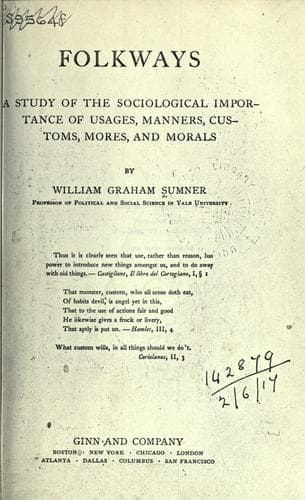
Folkways: A Study of the Sociological Importance of Usages, Manners, Customs, Mores, and MoralsSumner, William Graham
General
Folkways: A Study of the Sociological Importance of Usages, Manners, Customs, Mores, and Morals
Sumner, William Graham
Manners and customs
pilgrimages), commerce, industrial arts, money, credit, gunpowder, the
printing press, etc., produced.
+226. Sacerdotal celibacy.+ The church rode upon the tide and tried to
keep possession of the social power and use it for the interest of
ecclesiastics. Asceticism was in the mores. Everybody accepted the
ascetic standard of merit and holiness as correct and just, whether he
lived by it or not. Sacerdotal celibacy was a case of asceticism. Every
one knew that it had come about in church history and was not scriptural
or primitive. It was in the notions of the age that there were stages in
righteousness, and that religious persons were bound to live by higher
stages than persons not technically religious. Renunciation of sex was
higher righteousness than realization of sex, as is taught in the
seventh chapter of First Corinthians. This notion existed amongst
heathen and pagans. The priests in the Melkart temple at Gades (Cadiz)
were bound to celibacy.[475]
The merit of celibacy is a very old religious idea in Hindostan. The
Todas have a celibate priesthood.[476] "It is one of the inconsistencies
of the Hindu religion that it enjoins the duty of marriage on all, yet
honors celibacy as a condition of great sanctity, and a means of
acquiring extraordinary religious merit and influence."[477] "All the
ascetic sects of the Saivas are celibates."[478] Lamas at Shang (98 deg. E.
36 deg. N.) are allowed to marry, but not in Tibet.[479] The Christian
notion of the third century was that clerics ought to come up to the
higher standard. This was the purest and highest reason for celibacy. It
had been a standard of perfection in the Christian church for six
hundred years before Hildebrand. Whatever motives of policy or
ecclesiastical ambition may have been mixed with it in the eleventh
century, it had the merit of bringing doctrine and practice into accord.
Public-domain text, read in full here on John Shaqi.
Reviews
Reviews
No reviews yet
Be the first to share your thoughts on this work.
Elsewhere in the archive
Join the Discussion
Join the discussion
Sign in to leave a comment or review.
Sign InorCreate an account