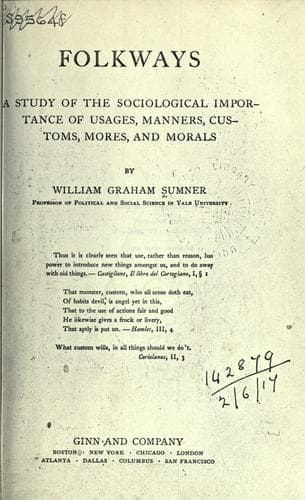
Folkways: A Study of the Sociological Importance of Usages, Manners, Customs, Mores, and MoralsSumner, William Graham
General
Folkways: A Study of the Sociological Importance of Usages, Manners, Customs, Mores, and Morals
Sumner, William Graham
Manners and customs
+274. Some men serving others. Freedom and equality. Figurative
use of "slavery."+ Must we infer, then, that there is a social
necessity that some men must serve others? In the New Testament
it is taught that willing and voluntary service of others is the
highest duty and glory of human life. If one man's strength is
spent on another man's struggle for existence, the survival of
the former in the competition of life is impaired. The men of
talent are constantly forced to serve the rest. They make the
discoveries and inventions, order the battles, write the books,
and produce the works of art. The benefit and enjoyment go to the
whole. There are those who joyfully order their own lives so that
they may serve the welfare of mankind. The whole problem of
mutual service is the great problem of societal organization. Is
it a dream, then, that all men should ever be free and equal? It
is at least evident that here ethical notions have been
interjected into social relations, with the result that we have
been taught to think of free and equal units willingly serving
each other. That, at least, is an idealistic dream. Yet it no
more follows from the fact that slavery has done good work in the
history of civilization that slavery should forever endure than
it follows from the fact that war has done good work in the
history of civilization that war is, in itself, a good thing.
Slavery alleviated the status of women; the domestication of
beasts of draft and burden alleviated the status of slaves; we
shall see below that serfs got freedom when wind, falling water,
and steam were loaded with the heavy tasks. Just now the heavy
burdens are borne by steam; electricity is just coming into use
to help bear them. Steam and electricity at last mean coal, and
the amount of coal in the globe is an arithmetical fact. When the
coal is used up will slavery once more begin? One thing only can
be affirmed with confidence; that is, that as no philosophical
dogmas caused slavery to be abolished, so no philosophical dogmas
can prevent its reintroduction if economic changes should make
it fit and suitable again. As steam has had put upon it the hard
work of life during the last two hundred years, the men have been
emancipated from ancient hard conditions and burdens, and the
generalities of the philosophers about liberty have easily won
greater and greater faith and currency. However, the mass of
mankind, taught to believe that they ought to have easy and
pleasant times here, begin to complain again about "wages
slavery," "debt slavery," "rent slavery," "sin slavery," "war
slavery," "marriage slavery," etc. What men do not like they call
"slavery," and so prove that it ought not to be. It appears to be
still in their experience that a free man is oppressed by
contracts of wages, debt, rent, and marriage, and that the cost
Public-domain text, read in full here on John Shaqi.
Reviews
Reviews
No reviews yet
Be the first to share your thoughts on this work.
Elsewhere in the archive
Join the Discussion
Join the discussion
Sign in to leave a comment or review.
Sign InorCreate an account