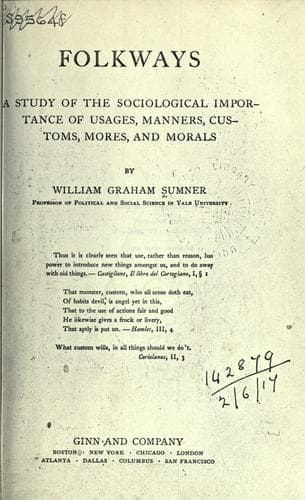
Folkways: A Study of the Sociological Importance of Usages, Manners, Customs, Mores, and MoralsSumner, William Graham
General
Folkways: A Study of the Sociological Importance of Usages, Manners, Customs, Mores, and Morals
Sumner, William Graham
Manners and customs
slave to a Somal, and war captives are not made slaves. Also
amongst the Galla it appears that debtor slavery does not exist.
Criminal slavery does, however, exist, and is used by the chiefs.
It is honorable to treat slaves well. In Kaffa the slaves are
lazy and pretentious, because they know that their owners do not
look to them for labor, but speculate on their children, whom
they will sell.[656] In general, in East Africa, the master-owner
has not the power of life and death, and the slave has a right of
property. "A headman (of a village) in debt sells first his
slaves, then his sisters, then his mother, and lastly his free
wives, after which he has nothing left."[657] Stuhlmann[658] says
that slaves in Uganda are well treated, as members of the family.
Brunache[659] says the same of the Congo tribes so far as they
have not been contaminated by contact with whites. This may be
regarded as characteristic of African slavery. The Vanika of
eastern Africa are herding nomads. They cannot use slaves, and
make war only to steal cattle.[660] Bushmen love liberty. They
submit to no slavery. They are hunters of a low grade. They hate
cattle, as the basis of a life which is different from (higher
than) their own. They massacre cattle which they cannot steal or
carry away.[661] Mungo Park described free negroes reduced to
slavery by famine.[662] In Ashanti a man and a woman discovered
in the act in the bush, or in the open air, are slaves of him who
discovered them, but they are redeemable by their families.[663]
Ashanti slavery is domestic and very mild. The slave marries his
master's daughter and plays with the master. He also eats from
the same dish.[664] Slavery of this form is never cruel or
harsh. Debt slavery is harder, for the services of the pawn count
for nothing on the debt.[665] The effect of the abolition of
slavery in Algeria was stupor amongst master-owners and grief
amongst slaves. The former wondered how it could be wrong to care
for persons who would have been eaten by their fellow-countrymen
if they had succumbed to the hard struggle for existence at home.
The latter saw themselves free--really free--in the desert, with
no supply of food, clothing, or other supplies, and no human
ties.[666] In all families of well-to-do people little negroes
are found. The author saw one who told her that the lady of the
house had suckled him.[667] It is reported from eastern Borneo
that a white man could hire no natives for wages. They thought it
degrading to work for wages, but if he would buy them they would
work for him.[668] In spite of what has been said above about
slavery on the west coast of Africa it is to be remembered that
the master-owner has the power of life and death and that he
often uses it. If he is condemned to death for a crime, he can
Public-domain text, read in full here on John Shaqi.
Reviews
Reviews
No reviews yet
Be the first to share your thoughts on this work.
Elsewhere in the archive
Join the Discussion
Join the discussion
Sign in to leave a comment or review.
Sign InorCreate an account