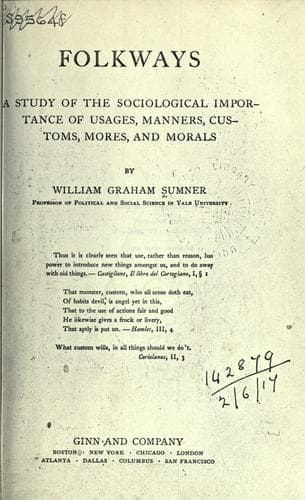
Folkways: A Study of the Sociological Importance of Usages, Manners, Customs, Mores, and MoralsSumner, William Graham
General
Folkways: A Study of the Sociological Importance of Usages, Manners, Customs, Mores, and Morals
Sumner, William Graham
Manners and customs
+42. Purpose of the present work.+ "Ethology" would be a convenient term
for the study of manners, customs, usages, and mores, including the
study of the way in which they are formed, how they grow or decay, and
how they affect the interests which it is their purpose to serve. The
Greeks applied the term "ethos" to the sum of the characteristic usages,
ideas, standards, and codes by which a group was differentiated and
individualized in character from other groups. "Ethics" were things
which pertained to the ethos and therefore the things which were the
standard of right. The Romans used "mores" for customs in the broadest
and richest sense of the word, including the notion that customs served
welfare, and had traditional and mystic sanction, so that they were
properly authoritative and sacred. It is a very surprising fact that
modern nations should have lost these words and the significant
suggestions which inhere in them. The English language has no derivative
noun from "mores," and no equivalent for it. The French _moeurs_ is
trivial compared with "mores." The German _Sitte_ renders "mores" but
very imperfectly. The modern peoples have made morals and morality a
separate domain, by the side of religion, philosophy, and politics. In
that sense, morals is an impossible and unreal category. It has no
existence, and can have none. The word "moral" means what belongs or
appertains to the mores. Therefore the category of morals can never be
defined without reference to something outside of itself. Ethics, having
lost connection with the ethos of a people, is an attempt to systematize
the current notions of right and wrong upon some basic principle,
generally with the purpose of establishing morals on an absolute
doctrine, so that it shall be universal, absolute, and everlasting. In a
general way also, whenever a thing can be called moral, or connected
with some ethical generality, it is thought to be "raised," and
disputants whose method is to employ ethical generalities assume
especial authority for themselves and their views. These methods of
discussion are most employed in treating of social topics, and they are
disastrous to sound study of facts. They help to hold the social
sciences under the dominion of metaphysics. The abuse has been most
developed in connection with political economy, which has been almost
robbed of the character of a serious discipline by converting its
discussions into ethical disquisitions.
Public-domain text, read in full here on John Shaqi.
Reviews
Reviews
No reviews yet
Be the first to share your thoughts on this work.
Join the Discussion
Join the discussion
Sign in to leave a comment or review.
Sign InorCreate an account