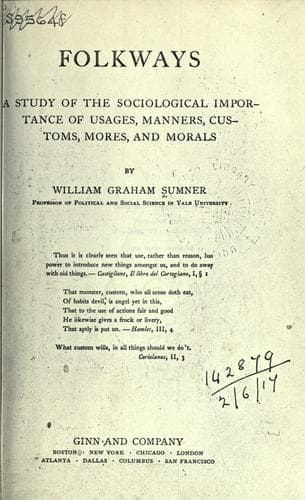
Folkways: A Study of the Sociological Importance of Usages, Manners, Customs, Mores, and MoralsSumner, William Graham
General
Folkways: A Study of the Sociological Importance of Usages, Manners, Customs, Mores, and Morals
Sumner, William Graham
Manners and customs
Next above these is another well-defined stratum,--the
self-supporting, but unskilled and illiterate. Then all who fall between
_PQ_ and _RS_ are characterized by mediocrity, and they constitute "the
masses." In all new countries, and as it would seem at the present time
also in central Europe, there is a very strong current upwards from the
lower to the upper strata of _PQRS_. Universal education tends to
produce such a current. Talented men of the period are very often born
in humble circumstances, but succeed in taking their true place in the
societal scale. It is true, of course, that there is a counter-current
of degenerate sons and grandsons. The present diagram is made
unsymmetrical with respect to _MN_ to express the opinion that the upper
strata of _PQRS_ (the lower professional and the semiprofessional
classes) are now, in any civilized society, larger in proportion than
symmetry would indicate.[68] The line _MN_ is therefore a mode, and the
class upon it is the modal class of the society, by means of which one
society might be compared with another.
+50.+ Galton estimated the number of men of genius in all history at
four hundred. An important fraction of these were related by blood. The
"men of the time" he rates at four hundred and fifty in a million, and
the more distinguished of them at two hundred and fifty in a million.
These latter he defines by saying that a man, to be included amongst
them, "should have distinguished himself pretty frequently, either by
purely original work, or as a leader of opinion." He finds that
illustrious men are only one in a million. On the other hand, idiots and
imbeciles in England and Wales are one in four hundred, of whom thirty
per cent can be educated so as to be equal to one third of a normal man
each; forty per cent can be made worth two thirds of a man; twenty-five
or thirty per cent pass muster in a crowd. Above these are silly persons
whose relatives shield them from public knowledge. Then above these come
the Dundreary type.[69]
Public-domain text, read in full here on John Shaqi.
Reviews
Reviews
No reviews yet
Be the first to share your thoughts on this work.
Join the Discussion
Join the discussion
Sign in to leave a comment or review.
Sign InorCreate an account