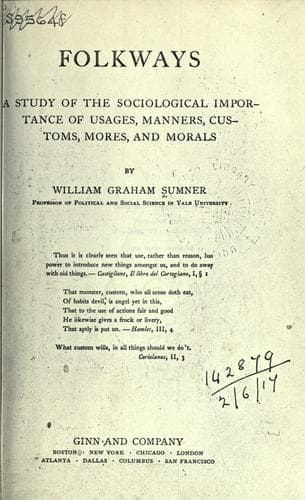
Folkways: A Study of the Sociological Importance of Usages, Manners, Customs, Mores, and MoralsSumner, William Graham
General
Folkways: A Study of the Sociological Importance of Usages, Manners, Customs, Mores, and Morals
Sumner, William Graham
Manners and customs
+51. Class; race; group solidarity.+ If the group which is classified is
a large one, and especially if it is a genetic unit (race, tribe, or
nation), there are no gaps in the series. Each individual falls into his
place by virtue of his characteristic differences. Just as no two are
anthropologically alike, so we may believe that no two are alike or
equal in societal value. That all men should be alike or equal, by any
standard whatever, is contrary to all the facts of human nature and all
the conditions of human life. Any group falls into subdivisions, the
members of each of which are approximately equal, when measured by any
standard, because the classification is imperfect. If we make it more
refined, the subdivisions must be subdivided again. We are in a dilemma:
we cannot describe mankind at all without categories, and if we go on to
make our categories more and more exact, each one of them would at last
contain only one person. Two things result which are practically
important, and which furnish us with scientific concepts which we can
employ in further study: (1) The classification gives us the notion of
the relative position of one, or a subdivision, in the entire group.
This is the sense of "class."[70] (2) The characteristic differences
furnish the notion of individuality and personality. The concept of a
race, as the term is now used, is that of a group clustered around a
mean with respect to some characteristic, and great confusion in the use
of the word "race" arises from the attempt to define races by their
boundaries, when we really think of them by the mean or mode, e.g. as to
skin color. The coherence, unity, and solidarity of a genetic group is
a very striking fact. It seems to conceal a play of mystic forces. It
is, in fact, no more mysterious than the run of dice. The propositions
about it would all become, in the last analysis, identical propositions;
e.g. it is most probable that we shall meet with the thing which is
present in the greatest number; or, it is most probable that the most
probable thing will happen. In the middle of the nineteenth century,
when attention was first called to the solidarity and internal
correlations of groups, especially if they were large and genetic, it
was believed that occult and far-reaching laws had been discovered. That
opinion has long been abandoned. If there are four dice in a box, each
having from one to six dots on its faces, the chance of throwing four
sixes is just the same as that of throwing four ones. The mean of the
sums of the dots which may fall uppermost is fourteen, which can be
produced by one hundred and forty-six throws. Suppose that the
components of social value are four,--intellectual, moral, physical,
economic,--represented by the four dice, and that the degrees are
represented by the dots. We should get four sixes once in twelve hundred
and ninety-six throws. Of the one hundred and forty-six throws which
give the mean fourteen, seventy-two show one six up.
Public-domain text, read in full here on John Shaqi.
Reviews
Reviews
No reviews yet
Be the first to share your thoughts on this work.
Join the Discussion
Join the discussion
Sign in to leave a comment or review.
Sign InorCreate an account