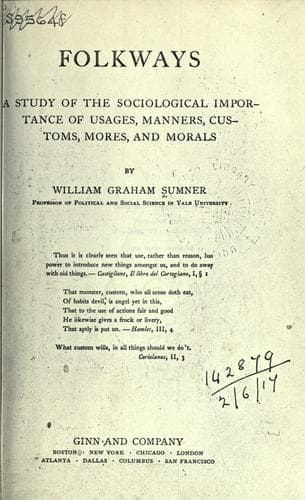
Folkways: A Study of the Sociological Importance of Usages, Manners, Customs, Mores, and MoralsSumner, William Graham
General
Folkways: A Study of the Sociological Importance of Usages, Manners, Customs, Mores, and Morals
Sumner, William Graham
Manners and customs
+53. Fallacies about the masses and classes.+ It is a fallacy to infer
that the masses have some occult wisdom or inspiration by virtue of
which they select what is wise, right, and good from what the classes
offer. There is, also, no device by which it is possible to obtain from
the masses, in advance or on demand, a judgment on any proposed changes
or innovations. The masses are not an oracle. If any answers can be
obtained on the problems of life, such answers will come rather from the
classes. The two sections of society are such that they may cooperate
with advantage to the good of all. Neither one has a right or a better
claim to rule the society.
+54. Action of the masses on thoughts.+ Fifty years ago Darwin put some
knowledge into the common stock. The peasants and artisans of his time
did nothing of the kind. What the masses do with thoughts is that they
rub them down into counters just as they take coins from the mint and
smooth them down by wear until they are only disks of metal. The masses
understand, for instance, that Darwin said that "men are descended from
monkeys." Only summary and glib propositions of that kind can ever get
currency. The learned men are all the time trying to recoin them and
give them at least partial reality. Ruskin set afloat some notions of
art criticism, which have penetrated all our cultivated classes. They
are not lost, but see what has become of them in fifty years by
popularization. A little later a new gospel of furniture and house
decoration was published. The masses have absorbed it. See what they
have made of it. Eastlake wanted no machine work, but machinery was not
to be defeated. It can make lopsided things if those are the fashion,
and it can make all the construction show if Eastlake has got the notion
into the crowd that the pegs ought to be on the outside. Thinking and
understanding are too hard work. If any one wants to blame the masses
let him turn to his own case. He will find that he thinks about and
understands only his own intellectual pursuit. He could not give the
effort to every other department of knowledge. In other matters he is
one of the masses and does as they do. He uses routine, set formulae,
current phrases, caught up from magazines and newspapers of the better
class.
Public-domain text, read in full here on John Shaqi.
Reviews
Reviews
No reviews yet
Be the first to share your thoughts on this work.
Elsewhere in the archive
Join the Discussion
Join the discussion
Sign in to leave a comment or review.
Sign InorCreate an account