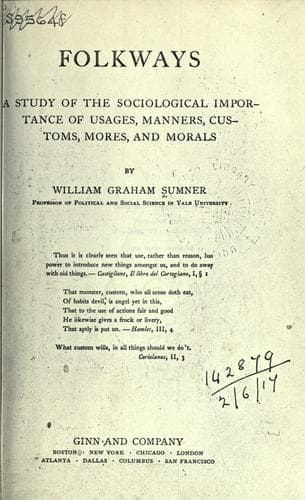
Folkways: A Study of the Sociological Importance of Usages, Manners, Customs, Mores, and MoralsSumner, William Graham
General
Folkways: A Study of the Sociological Importance of Usages, Manners, Customs, Mores, and Morals
Sumner, William Graham
Manners and customs
The conservatism of the
masses is of a different kind. It is not produced by interests, but it
is instinctive. It is due to inertia. Change would make new effort
necessary to win routine and habit. It is therefore irksome. The masses,
moreover, have not the power to reach out after "improvements," or to
plan steps of change by which needs might be better satisfied. The mores
of any society, at a period, may be characterized by the promptness or
reluctance of the masses to imitate the ways of the classes. It is a
question of the first importance for the historian whether the mores of
the historical classes of which he finds evidence in documentary remains
penetrated the masses or not. The masses are the real bearers of the
mores of the society. They carry tradition. The folkways are their ways.
They accept influence or leadership, and they imitate, but they do so as
they see fit, being controlled by their notions and tastes previously
acquired. They may accept standards of character and action from the
classes, or from foreigners, or from literature, or from a new religion,
but whatever they take up they assimilate and make it a part of their
own mores, which they then transmit by tradition, defend in its
integrity, and refuse to discard again. Consequently the writings of the
literary class may not represent the faiths, notions, tastes, standards,
etc., of the masses at all. The literature of the first Christian
centuries shows us scarcely anything of the mores of the time, as they
existed in the faith and practice of the masses. Every group takes out
of a new religion which is offered to it just what it can assimilate
with its own traditional mores. Christianity was a very different thing
amongst Jews, Egyptians, Greeks, Germans, and Slavs. It would be a great
mistake to suppose that any people ever accepted and held philosophical
or religious teaching as it was offered to them, and as we find it
recorded in the books of the teachers. The mores of the masses admit of
no such sudden and massive modification by doctrinal teaching. The
process of assimilation is slow, and it is attended by modifying
influences at every stage. What the classes adopt, be it good or ill,
may be found pervading the mass after generations, but it will appear as
a resultant of all the vicissitudes of the folkways in the interval. "It
was the most frightful feature of the corruption of ancient Rome, that
it extended through every class in the community."[73] "As in the
Renaissance, so now [in the Catholic reaction] vice trickled downward
from above, infiltrating the mass of the people with its virus."[74] It
is the classes who produce variation; it is the masses who carry forward
the traditional mores.
Public-domain text, read in full here on John Shaqi.
Reviews
Reviews
No reviews yet
Be the first to share your thoughts on this work.
Elsewhere in the archive
Join the Discussion
Join the discussion
Sign in to leave a comment or review.
Sign InorCreate an account