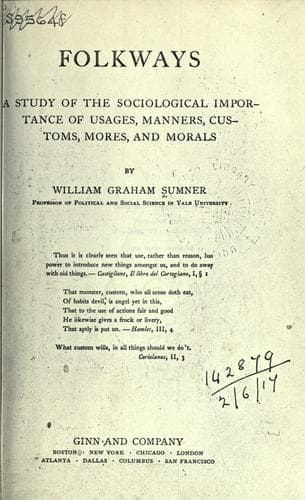
Folkways: A Study of the Sociological Importance of Usages, Manners, Customs, Mores, and MoralsSumner, William Graham
General
Folkways: A Study of the Sociological Importance of Usages, Manners, Customs, Mores, and Morals
Sumner, William Graham
Manners and customs
+56. Institutions of civil liberty.+ Institutions also must be produced
which will hold the activities of society in channels of order,
deliberation, peace, regulated antagonism of interests, and justice,
according to the mores of the time. These institutions put an end to
exploitation and bring interests into harmony under civil liberty. But
where do the institutions come from? The masses have never made them.
They are produced out of the mores by the selection of the leading men
and classes who get control of the collective power of the society and
direct it to the activities which will (as they think) serve the
interests which they regard as most important. If changes in life
conditions occur, the interests to be served change. Great inventions
and discoveries, the opening of new continents, new methods of
agriculture and commerce, the introduction of money and financial
devices, improved state organization, increase the economic power of the
society and the force at the disposal of the state. Industrial interests
displace military and monarchical interests as the ones which the state
chiefly aims to serve, not because of any tide of "progress," but
because industrialism gives greater and more varied satisfactions to the
rulers. The increase of _power_ is the primary condition. The classes
strive with each other for the new power. Peace is necessary, for
without peace none of them can enjoy power. Compromise, adjustment of
interests, antagonistic cooperation (sec. 21), harmony, are produced,
and institutions are the regulative processes and apparatus by which
warfare is replaced by system. The historical process has been full of
error, folly, selfishness, violence, and craft. It is so still. The
point which is now important for us is that the masses have never
carried on the struggles and processes by which civilized society has
been made into an arena, within which exploitation of man by man is to
some extent repressed, and where individual self-realization has a large
scope, under the institutions of civil liberty. It is the historical and
selected classes which have done this, often enough without intending or
foreseeing the results of actions which they inaugurated with quite
other, perhaps selfish, class purposes in view. A society is a whole
made up of parts. All the parts have a legitimate share in the acts and
sufferings of the society. All the parts contribute to the life and work
of the society. We inherit all the consequences of all their acts. Some
of the consequences are good and some are bad. It is utterly impossible
to name the classes which have done useful work and made beneficial
sacrifices only, and the other classes which have been idle burdens and
mischief makers only. All that has been done has been done by all. It is
evident that no other view than this can be rational and true, for one
reason because the will and intention of the men of to-day in what they
Public-domain text, read in full here on John Shaqi.
Reviews
Reviews
No reviews yet
Be the first to share your thoughts on this work.
Elsewhere in the archive
Join the Discussion
Join the discussion
Sign in to leave a comment or review.
Sign InorCreate an account