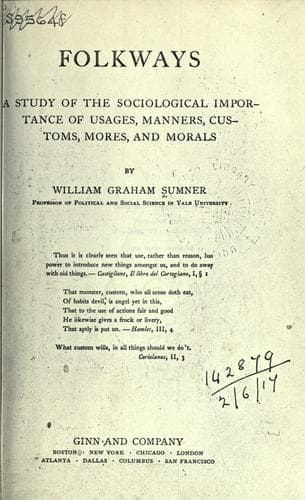
Folkways: A Study of the Sociological Importance of Usages, Manners, Customs, Mores, and MoralsSumner, William Graham
General
Folkways: A Study of the Sociological Importance of Usages, Manners, Customs, Mores, and Morals
Sumner, William Graham
Manners and customs
do has so little to do with the consequences to-morrow of what they do.
The notion that religion, or marriage, or property, or monarchy, as we
have inherited them, can be proved evil, or worthy of condemnation and
contempt on account of the selfishness and violence interwoven with
their history, is one of the idlest of all the vagaries of the social
philosophers.
+57. The common man.+ Every civilized society has to carry below the
lowest sections of the masses a dead weight of ignorance, poverty,
crime, and disease. Every such society has, in the great central section
of the masses, a great body which is neutral in all the policy of
society. It lives by routine and tradition. It is not brutal, but it is
shallow, narrow-minded, and prejudiced. Nevertheless it is harmless. It
lacks initiative and cannot give an impulse for good or bad. It produces
few criminals. It can sometimes be moved by appeals to its fixed ideas
and prejudices. It is affected in its mores by contagion from the
classes above it. The work of "popularization" consists in bringing
about this contagion. The middle section is formed around the
mathematical mean of the society, or around the mathematical mode, if
the distribution of the subdivisions is not symmetrical. The man on the
mode is the "common man," the "average man," or the "man in the street."
Between him and the democratic political institutions--the pulpit, the
newspapers, and the public library--there is a constant reaction by
which mores are modified and preserved. The aim of all the institutions
and literature in a modern state is to please him. His aim is to get out
of them what suits him. The yellow newspapers thrive and displace all
the others because he likes them. The trashy novels pay well because his
wife and daughters like them. The advertisements in the popular
magazines are addressed to him. They show what he wants. The "funny
items" are adjusted to his sense of humor. Hence all these things are
symptoms. They show what he "believes in," and they strengthen his
prejudices. If all art, literature, legislation, and political power are
to be cast at his feet, it makes some difference who and what he is. His
section of society determines the mores of the whole.
Public-domain text, read in full here on John Shaqi.
Reviews
Reviews
No reviews yet
Be the first to share your thoughts on this work.
Elsewhere in the archive
Join the Discussion
Join the discussion
Sign in to leave a comment or review.
Sign InorCreate an account