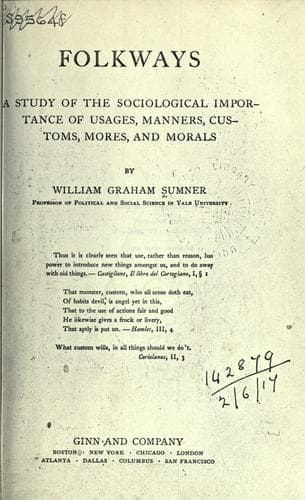
Folkways: A Study of the Sociological Importance of Usages, Manners, Customs, Mores, and MoralsSumner, William Graham
General
Folkways: A Study of the Sociological Importance of Usages, Manners, Customs, Mores, and Morals
Sumner, William Graham
Manners and customs
but the habits persist. Primitive religion is ritualistic, not because
religion makes ritual, but because ritual makes religion. Ritual is
something to be done, not something to be thought or felt. Men can
always perform the prescribed act, although they cannot always think or
feel prescribed thoughts or emotions. The acts may bring up again, by
association, states of the mind and sentiments which have been connected
with them, especially in childhood, when the fantasy was easily affected
by rites, music, singing, dramas, etc. No creed, no moral code, and no
scientific demonstration can ever win the same hold upon men and women
as habits of action, with associated sentiments and states of mind,
drilled in from childhood. Mohammedanism shows the power of ritual. Any
occupation is interrupted for the prayers and prescribed genuflections.
The Brahmins also observe an elaborate daily ritual. They devote to it
two hours in the morning, two in the evening, and one at midday.[80]
Monks and nuns have won the extreme satisfaction of religious sentiment
from the unbroken habit of repeated ritual, with undisturbed opportunity
to develop the emotional effects of it.
+68. The ritual of the mores.+ The mores are social ritual in which we
all participate unconsciously. The current habits as to hours of labor,
meal hours, family life, the social intercourse of the sexes, propriety,
amusements, travel, holidays, education, the use of periodicals and
libraries, and innumerable other details of life fall under this ritual.
Each does as everybody does. For the great mass of mankind as to all
things, and for all of us for a great many things, the rule to do as all
do suffices. We are led by suggestion and association to believe that
there must be wisdom and utility in what all do. The great mass of the
folkways give us discipline and the support of routine and habit. If we
had to form judgments as to all these cases before we could act in them,
and were forced always to act rationally, the burden would be
unendurable. Beneficent use and wont save us this trouble.
Public-domain text, read in full here on John Shaqi.
Reviews
Reviews
No reviews yet
Be the first to share your thoughts on this work.
Elsewhere in the archive
Join the Discussion
Join the discussion
Sign in to leave a comment or review.
Sign InorCreate an account