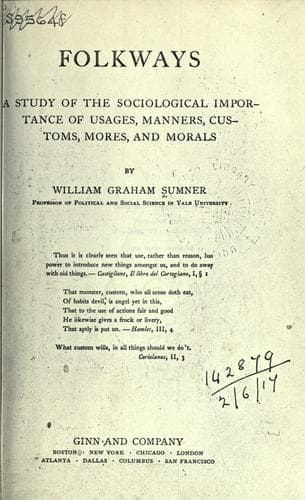
Folkways: A Study of the Sociological Importance of Usages, Manners, Customs, Mores, and MoralsSumner, William Graham
General
Folkways: A Study of the Sociological Importance of Usages, Manners, Customs, Mores, and Morals
Sumner, William Graham
Manners and customs
+102. Social policy.+ In Germany an attempt has been made to develop
social policy into an art (_Socialpolitik_). Systematic attempts are
made to study demographical facts in order to deduce from them
conclusions as to the things which need to be done to make society
better. The scheme is captivating. It is one of the greatest needs of
modern states, which have gone so far in the way of experimental devices
for social amelioration and rectification, at the expense of tax payers,
that those devices should be tested and that the notions on which they
are based should be verified. So far as demographical information
furnishes these tests it is of the highest value. When, however, the
statesmen and social philosophers stand ready to undertake any
manipulation of institutions and mores, and proceed on the assumption
that they can obtain data upon which to proceed with confidence in that
undertaking, as an architect or engineer would obtain data and apply his
devices to a task in his art, a fallacy is included which is radical and
mischievous beyond measure. We have, as yet, no calculus for the
variable elements which enter into social problems and no analysis which
can unravel their complications. The discussions always reveal the
dominion of the prepossessions in the minds of the disputants which are
in the mores. We know that an observer of nature always has to know his
own personal equation. The mores are a societal equation. When the
mores are the thing studied in one's own society, there is an operation
like begging the question. Moreover, the convictions which are in the
mores are "faiths." They are not affected by scientific facts or
demonstration. We "believe in" democracy, as we have been brought up in
it, or we do not. If we do, we accept its mythology. The reason is
because we have grown up in it, are familiar with it, and like it.
Argument would not touch this faith. In like manner the people of one
state believe in "the state," or in militarism, or in commercialism, or
in individualism. Those of another state are sentimental, nervous, fond
of rhetorical phrases, full of group vanity. It is vain to imagine that
any man can lift himself out of these characteristic features in the
mores of the group to which he belongs, especially when he is dealing
with the nearest and most familiar phenomena of everyday life. It is
vain to imagine that a "scientific man" can divest himself of prejudice
or previous opinion, and put himself in an attitude of neutral
independence towards the mores. He might as well try to get out of
gravity or the pressure of the atmosphere. The most learned scholar
reveals all the philistinism and prejudice of the man-on-the-curbstone
when mores are in discussion. The most elaborate discussion only
consists in revolving on one's own axis. One only finds again the
prepossessions which he brought to the consideration of the subject,
returned to him with a little more intense faith. The philosophical
Public-domain text, read in full here on John Shaqi.
Reviews
Reviews
No reviews yet
Be the first to share your thoughts on this work.
Elsewhere in the archive
Join the Discussion
Join the discussion
Sign in to leave a comment or review.
Sign InorCreate an account