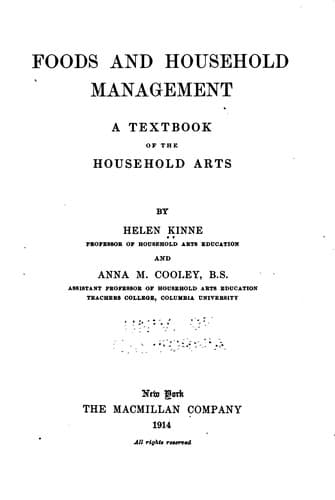
Foods and Household Management: A Textbook of the Household ArtsKinne, Helen
General
Foods and Household Management: A Textbook of the Household Arts
Kinne, Helen
Cooking; Food; Home economics
=Methods of mixing and the rising of bread.=——Dissolve the yeast in a
portion of the liquid, stir this mixture into the remaining liquid, add
half the flour, and beat the mixture thoroughly at this stage. Add the
sugar if any is to be used. When this soft mixture, called the “sponge,”
becomes full of bubbles, add the salt, the shortening if used, and the
remaining flour. Knead the dough by the hand, or by the machine, for about
ten minutes, or until it is smooth and elastic. Put it into a greased
bowl, cover the bowl, and allow the dough to remain until it doubles its
bulk. Some bread makers knead in all the flour at the first, and obtain a
good result. The first rising is more rapid, however, and experience seems
to prove that the results are better on the whole with the sponge. Cut the
dough down, knead again, using as little flour as possible. Shape into
loaves, place the loaves in greased pans, cover, and leave again until the
loaves double their bulk, when they are ready for baking. If left too
long, the bubbles of gas become too large.
_Temperature_ and _time_ are important, in this matter of mixing and
rising. The process may be shortened to five or six hours, including the
baking, or lengthened to twenty-four by the choice of the amount of yeast
and the temperature. The shorter process is the better, on the whole.
After reading over the sections of the chapter on preservation of fruit,
performing the yeast experiments, and discussing the results, you will be
able to answer these questions:
1. What should be the temperature of the ingredients when the bread is
mixed?
2. If milk is used, how may the souring of the milk be prevented?
3. What temperature will you secure for the bread while it is rising?
4. If an emergency occurs, and the dough cannot be kneaded or baked at the
moment it is ready, what can be done? Can you think of two expedients?
=A few suggestions.=——The kneading stretches the gluten and long kneading
gives a fine grain. In such a recipe as that for the making of Parker
House rolls, a very delicate quality results from a protracted process;
one old-fashioned housekeeper recommends a half hour’s kneading three
times. Fortunately a sufficiently good bread or roll may be made by ten or
fifteen minutes’ kneading at a time.
Bread dough may be cut or stirred with a large knife in place of the
kneading, and this is a good method to teach to those who live in crowded
space and find it difficult to have a perfectly clean kitchen and proper
utensils. With this method the dough must be softer, and it remains in the
bowl until it is turned into the baking pan. The resulting loaf is
somewhat moist, and not fine-grained, but the flavor is good.
Brushing the surface of the dough in the bowl or pan with water or milk
will prevent the formation of a dry crust on the top.
Public-domain text, read in full here on John Shaqi.
Reviews
Reviews
No reviews yet
Be the first to share your thoughts on this work.
Elsewhere in the archive
Join the Discussion
Join the discussion
Sign in to leave a comment or review.
Sign InorCreate an account