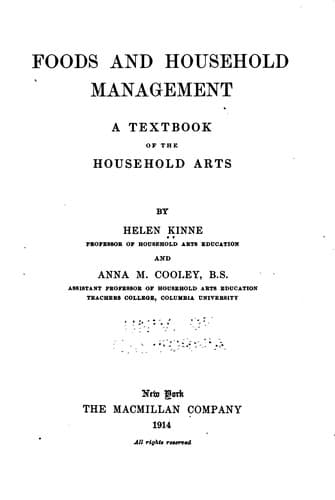
Foods and Household Management: A Textbook of the Household ArtsKinne, Helen
General
Foods and Household Management: A Textbook of the Household Arts
Kinne, Helen
Cooking; Food; Home economics
4. What are the advantages of a vacuum cleaner over a broom?
5. What are the best methods of removing dust? Of cleaning paint and
woodwork and glass?
6. How are metals cleaned?
7. What are the most important points in caring for a bedroom?
8. What is the order of work in a thorough cleaning of a room, and why?
9. How should plumbing be cleaned?
10. Is the old-fashioned order of work the best now——Monday, washing;
Tuesday, ironing; Wednesday, mending; Thursday and Friday, cleaning; and
Saturday, baking?
11. How may all the family help to some extent in household work?
12. Can you plan the best order of work for a day for the home worker who
has no help but some one to wash and iron?
13. What are the dangers from different household insects?
14. If a kerosene lamp suddenly blazes up, what should you do?
15. What is the principle involved in putting out a fire?
16. What are some of the simple methods of fire prevention?
17. What simple repairing can be done by members of the family?
CHAPTER XXIII
LAUNDERING AND DRY CLEANSING
“Washing is a necessity, ironing a luxury.” This terse sentence expresses
very clearly the relative value of the two large divisions of the
laundering process. The thorough washing of clothing is a most important
branch of household sanitation, upon which the health of the family and of
the whole community depends, for disease is communicable by means of
soiled garments and those that are imperfectly cleansed in unsanitary
houses and possibly in commercial laundries. The ideal city will have many
large and spotlessly clean laundries, where skilled labor intelligently
directed will insure clothing as clean as it can possibly be made.
There is an æsthetic element in laundering as well, for good washing
methods give a tinted white to fabrics that it is a pleasure to see, and
ironing makes a smoothness that is pleasant to the touch, and brings out
beauty of design, as in damasks and embroideries. There is an economic
feature, too, in that poor and rough methods of work in both washing and
ironing injure fabrics and shorten their term of usableness.
“Washing Day” has an ill repute that it does not deserve, for laundering
is a science and an art that it is a pleasure to practice, if one has
skill. Make it one of the household arts which you must carefully study,
and you will find it pleasurable as well as necessary.
=Soil in garments.=——The dust and dirt of the street and house that soil
our garments contain inorganic particles of earth, lint from textiles,
organic matter from animals and human beings, and also bacteria. The
material from our bodies consists of particles of skin, skin secretions,
and bacteria, which are collected in underwear and bed linen and towels.
Spots of grease and stains may fall upon our outer clothing, and fruit
stains affect table linen in particular.
Public-domain text, read in full here on John Shaqi.
Reviews
Reviews
No reviews yet
Be the first to share your thoughts on this work.
Elsewhere in the archive
Join the Discussion
Join the discussion
Sign in to leave a comment or review.
Sign InorCreate an account