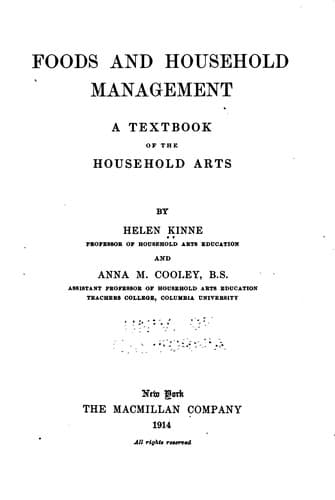
Foods and Household Management: A Textbook of the Household ArtsKinne, Helen
General
Foods and Household Management: A Textbook of the Household Arts
Kinne, Helen
Cooking; Food; Home economics
In Part I of this book the author introduces the student to more than
twenty standard English classics, giving in connection with each a brief
explanatory introduction, suggestions for study and topics for oral and
written discussion. These classics are grouped with respect to the
different types of literature which they represent,——epic, drama, essay,
novel, etc., and there is a brief exposition of the type. The result is
that in the mind of the reader the individual masterpiece and the type
with its characteristics are inseparably connected.
Part II consists of a brief but masterly survey of English literature. The
book as a whole serves to systematize and unify the study of secondary
school literature,——a most desirable end.
Professor E. A. Cross, State Teachers College, Greeley, Colo. “It meets
with my heartiest approval. It is brief, considers all the writers high
school students need to know, touches the interesting features in the
lives and works of these men,——about all you could want it to do.”
Mr. John B. Opdycke, English Department of the High School of Commerce,
New York City. “I like it very much indeed. It has just enough in its
review of the history of English literature, and its treatment of the
classics is restrained and dignified. So far as I have seen, this is the
only book that combines the two in one volume. I am all against the use of
an abstract History of English Literature in the high school and I am all
in favor of putting into the hands of the students some book that analyzes
classics fully and yet with restraint. This book seems to have combined
the two in just the right proportions and treated them in just the right
manner.”
THE MACMILLAN COMPANY
Publishers 64-66 Fifth Ave. New York City
Boston Chicago Atlanta Dallas San Francisco
* * * * *
FOOTNOTES:
[Footnote 1: TEACHER’S NOTE.——The term “foodstuff” is used in place of
“food principle,” as being the later and better term.]
[Footnote 2: This is the “greater calorie” or “kilogram calorie,” and is
written Calorie to distinguish it from the “lesser calorie” or “gram
calorie,” largely used in physics and chemistry.]
[Footnote 3: TEACHER’S NOTE.——The machines operating with a crank are
examples of the “wheel and axle,” or the windlass, or both. The mechanical
advantage can be worked out mathematically,——a good problem for the
physics or mathematics class. See “Household Physics,” C. J. Lynde.]
[Footnote 4: TEACHER’S NOTE.——A good way to study utensils is to begin
with the school kitchen equipment. Utensils for the home kitchen can be
listed in the notebook, as these are used in the school kitchen, having
the list grow by degrees throughout the year. For reference, have a price
list and illustrated catalogue from some good firm.]
Public-domain text, read in full here on John Shaqi.
Reviews
Reviews
No reviews yet
Be the first to share your thoughts on this work.
Elsewhere in the archive
Join the Discussion
Join the discussion
Sign in to leave a comment or review.
Sign InorCreate an account