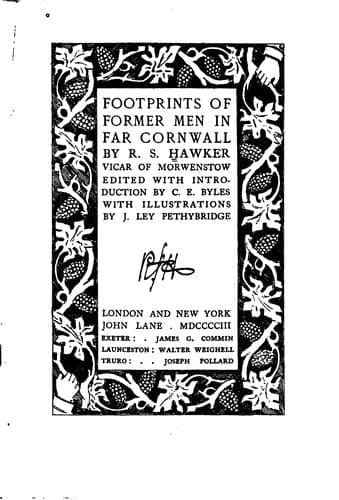
Footprints of Former Men in Far CornwallHawker, Robert Stephen
History
Footprints of Former Men in Far Cornwall
Hawker, Robert Stephen
Cornwall (England : County) -- History
Four shillings and sixpence for bed and board for two wolfish appetites
for a night and a day, to say nothing of the pantomime performed
gratuitously for our behoof, at a very early hour, by Boscastle
amateurs! Good day, Mrs. Treworgy! good day! “To-morrow to fresh woods
and pastures new.”
FOOTNOTES:
[116] From _Belgravia_, vol. iii. pp. 328-337. 1867.
[117] The author and Rev. Dr. Jeune, afterwards Bishop of Peterborough,
father of Sir Francis Jeune.
[118]
“O type of a far scene! the lovely land,
Where youth wins many a friend, and I had one;
Still do thy bulwarks, dear old Oxford, stand?
Yet, Isis, do thy thoughtful waters run?”
_The Token Stream of ‘Tidna’ Combe._
(See Appendix A.)
[119] Compare Tennyson, “In Memoriam”--
“For, ‘ground in yonder social mill
We rub each other’s angles down,
‘And merge,’ he said, ‘in form and gloss,
The picturesque of man and man.’”
[120] Such things have been known to occur even in these degenerate
days.
[121] A variant of a line in Hawker’s poem, “A Legend of the Hive.”
[122] The Oxford crone speaks with a Cornish accent, and some think
that she hailed from Stratton.
[123] Hawker came in contact, however, with some of the leaders of
the Oxford Movement, as we learn from a letter where he says: “How I
recollect their faces and words--Newman, Pusey, Ward, Marriott; they
used to be all in the common-room every evening, discussing, talking,
reading.” Hawker went up to Oxford in 1822, and won the Newdigate in
1827, when Newman was a Tutor of Oriel and Keble was publishing “The
Christian Year.”
[124] One of the kind so often used by Wesley for his open-air sermons
in Cornwall. See p. 160.
[125] Compare Hawker’s poem,“Trebarrow,” and his footnote thereto.
[126] From the description of Carradon in “The Quest of the Sangraal.”
[127]
“Kings of the main their leaders brave,
Their barks the dragons of the wave.”
_Lay of the Last Minstrel._
[128] Compare Hawker’s well-known ballad, “The Silent Tower of
Bottreaux.”
[129] There were no “earls” of Bottreaux. Knights, or barons, would be
more correct.
[130] Wizard.
[131] See Appendix J.
[132] Compare Tennyson--
“that gray king, whose name, a ghost,
Streams like a cloud, man-shaped, from mountain peak,
And cleaves to cairn and cromlech still.”
[133]
“One breed may rise, another fall;
The Berkshire hog survives them all.”
It was, perhaps, in commemoration of this episode that Hawker when
afterwards curate of North Tamerton, kept a tame Berkshire pig. Another
parson-poet, Robert Herrick, is also said to have had a pet porker.
[134] Compare p. 204.
[135] Compare p. 202.
[136] An escapade with pigs occurs in Tennyson’s poem, “Walking to the
Mail.”
[137] Pembroke.
HOLACOMBE
Public-domain text, read in full here on John Shaqi.
Reviews
Reviews
No reviews yet
Be the first to share your thoughts on this work.
Elsewhere in the archive
Join the Discussion
Join the discussion
Sign in to leave a comment or review.
Sign InorCreate an account