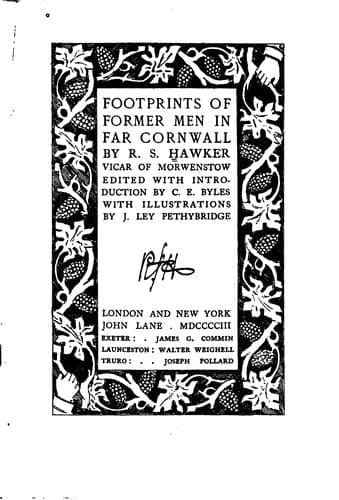
Footprints of Former Men in Far CornwallHawker, Robert Stephen
History
Footprints of Former Men in Far Cornwall
Hawker, Robert Stephen
Cornwall (England : County) -- History
filled with his favourite wine--“sound old Tory port”--to recall in
whole volumes the events of his youth and manhood, and to dilate with
emphatic gusto on the contrasts of the age and times.
The personal aspect of my friend presented an imposing solemnity to
the eye. Tall, even to the measure of six feet two inches, but slender
withal as the bole of a poplar-tree, with small features and twinkling
eye, and a round undersized head, and yet with a demeanour so pompous,
such a frequency of condescending bows, and such a roll of words, that
he took immediate rank as a gentleman of the old school. And as to his
mental endowments, be it enough to record that there were few men as
wise as he looked. His garb was that of a pluralized clergyman of the
days of the Georges,--fine black broadcloth, that hung around him in
festive moments like mourning on a Maypole. His vest was of rich silk
with wide pockets, roomy enough to hold the inevitable snuff-box, the
gold _étui_, and the small cock-fighter’s saw, which was used to cut
away the natural spur of the bird when it was replaced with steel. This
last was a common equipment of a country gentleman, lay or clerical, in
those days. His apparel terminated in black silk stockings and nether
garments, buckled with gold or silver at the knee. Buckles also clasped
his shoes. Thus attired, he was no unfit representative of the clergy
who ruled and reigned in their parochial domain in the west of England
in the early part of the eighteenth century. His conversational powers
were ample and amusing; but it was when he could be brought to dilate
on his own adventures and history in earlier life that he most surely
riveted and requited the attention of his auditors.
At my table one day the topic of discourse was the marriage of the
clergy. “The young curates,” said he, “should always marry, and that
as soon as ever they are ordained. Nothing brightens up a parsonage
like the ribbons of a merry wife. I, you know, have buried three Mrs.
Vivians; and when I come to look back, I really can hardly decide
which it was that made the happiest home. If I had to live my life
over again, I should certainly marry all three. And yet I did not win
my first love, after all. Her grumpy old father came between us and
blighted our days, as the Psalmist puts it. Ah! the very sound of her
name is like a charm to me still. Bridget Morrice! But ‘Biddy’ she was
always called at home; and very soon she was ‘Biddy dear’ to me.
Public-domain text, read in full here on John Shaqi.
Reviews
Reviews
No reviews yet
Be the first to share your thoughts on this work.
Elsewhere in the archive
Join the Discussion
Join the discussion
Sign in to leave a comment or review.
Sign InorCreate an account