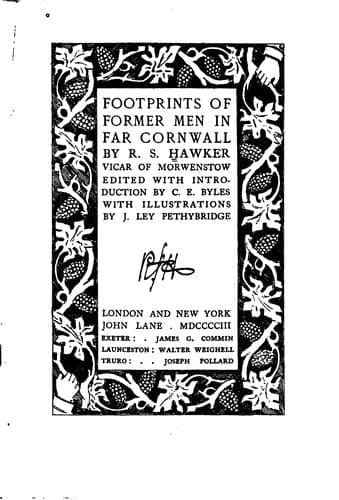
Footprints of Former Men in Far CornwallHawker, Robert Stephen
History
Footprints of Former Men in Far Cornwall
Hawker, Robert Stephen
Cornwall (England : County) -- History
non breve duratura, in statum congruum et sufficientem reparent
et reficiant hac vice prima; quodque extunc custodia eorundem
et reparacio pro tempore successuro, una cum omnibus oneribus
ordinariis integraliter, et extraordinariis pro quarta parte
dumtaxat, ad Vicarium qui pro tempore fuerit pertineant; residua
parte dictorum onerum extraordinariorum, una cum sustentatione,
reparatione, et reedificatione Cancelli ipsius Ecclesie dictis
Religiosis totaliter incumbente.--In cujus rei testimonium nos,
Thomas, Exoniensis Episcopus supradictus, sigillum nostrum, et nos,
prefati Magister et Fratres sigillum nostrum commune Presentibus
duximus apponendum.--Data apud Chidleghe, xiij^o Calendas Junii
[May 20th], Anno Domini Millesimo ducentesimo nonagesimo sexto.
“Hec Taxatio vere est Registrata,
“WILLELMUS GERMYNE.”
The Editor points out, in an interesting note, that the certified copy
of this, which was used by Mr. Hawker, has “Tidnacombis” instead of
“Tunnacombis.” In the Register itself the letter “u” is turned up at
the end, the usual contracted form of “un,” but the writing is obscure;
and, although experts would read it correctly without hesitation, it
might easily, in this case, be mistaken for “id” by others. One of Mr.
Hawker’s most beautiful poems is entitled “The Token Stream of Tidna
Combe.” It is interesting to note that Stanbury was the birthplace of
John Stanbury, Bishop of Hereford, who died 1474. He was confessor
to Henry VI., and was nominated the first Provost of Eton College,
although he never took up the office.
The following curious tradition relating to the extremely rude font is
quoted by Lieut.-Colonel Harding in a paper on Morwenstow Church in the
“Transactions of the Exeter Diocesan Architectural Society” (Second
Series, vol. i. p. 216). It has been preserved among some valuable MSS.
which belong to the Coffin family of Portledge, near Bideford, and were
collected by an antiquary of that family about three hundred years ago.
“Moorwinstow, its name is from St. Moorin. The tradition is, that
when the parishioners were about to build their church, this saint
went down under the cliff and chose a stone for the font which she
brought up upon her head. In her way, being weary, she lay down the
stone and rested herself, out of which place sprang a well, from
thence called St. Moorin’s well. Then she took it up and carried
it to the place where now the church standeth. The parishioners
had begun their church in another place, and there did convey this
stone, but what was built by day was pulled down by night, and the
materials carried to this place; whereupon they forbare, and built
it in the place they were directed to by a wonder.”
The date on one of the capitals seems to be 1564 instead of 1475. The
inscription runs round the capital, each of the twenty letters being on
a separate face, thus--
“THIS WAS MADE ANNO MVCLX4”
Public-domain text, read in full here on John Shaqi.
Reviews
Reviews
No reviews yet
Be the first to share your thoughts on this work.
Elsewhere in the archive
Join the Discussion
Join the discussion
Sign in to leave a comment or review.
Sign InorCreate an account