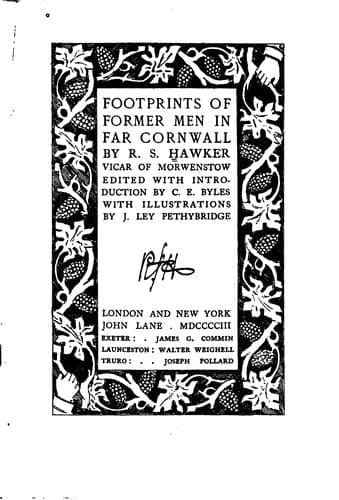
Footprints of Former Men in Far CornwallHawker, Robert Stephen
History
Footprints of Former Men in Far Cornwall
Hawker, Robert Stephen
Cornwall (England : County) -- History
If the song existed in 1710, and referred to this John Arscott, it was
no doubt written still earlier. The last of the Arscotts, however,
Black John’s master, would seem more likely to be the subject of it.
Mr. Baring-Gould, who includes it among his “Songs of the West,” says
that one of the many versions supplied to him was dated 1772, which
would suit this theory. Hawker himself published the song in “Willis’s
Current Notes” for December, 1853, and it has since his death been
erroneously included in his poems, for apparently he only claimed
to have been the first to print it, though he doubtless added some
touches of his own. Black John is mentioned in his version, and Mr.
Baring-Gould says that “the author of the song is said to have been
one Dogget, who used to run after Arscott’s fox-hounds on foot.” A
search for this name in the parish registers of Tetcott and Stratton
has proved unsuccessful. Mr. R. P. Chope found a version of the song
current at Hartland, and an old man there (over eighty in 1903) says
that his father used to sing it seventy years ago.
From Luke’s book we learn that--
“The Old house at Tetcott, which, as well as the mansion of
Dunsland, had been built under the superintendence of the Architect
sent by the government of Charles II. to build Stowe for the Earl
of Bath, was taken down in 1831, and a Gothic cottage constructed
in its stead. The demolition of the ancient structure was a very
unpopular act, and the old crones of the neighbourhood shake their
heads and say that Black John and Driver (a staghound), when the
Cottage was burnt down a few years only after it had been built,
were seen yelling and dancing round the flames. The origin of that
fire was never ascertained.”
[Illustration: STOWE: THE RESIDENCE OF JOHN, EARL OF BATH, SON OF SIR
BEVILL GRANVILLE]
Hawker’s poem, “Tetcott, 1831,” which is all his own, is an elegy on
the destruction of the old house. He quotes one stanza of it on p. 87
of the present volume. The present representative of John Arscott’s
family, Mrs. Ford, of Pencarrow, describes Tetcott as “an imposing
Queen Anne’s house,” and speaks of “the front door steps under which
John Arscott’s pet toad resided, and every morning came out to be fed
by his kind master till the envious peacock killed him.”
* * * * *
Mrs. Calmady, of Great Tree, Chagford, writes as follows:--
Public-domain text, read in full here on John Shaqi.
Reviews
Reviews
No reviews yet
Be the first to share your thoughts on this work.
Elsewhere in the archive
Join the Discussion
Join the discussion
Sign in to leave a comment or review.
Sign InorCreate an account