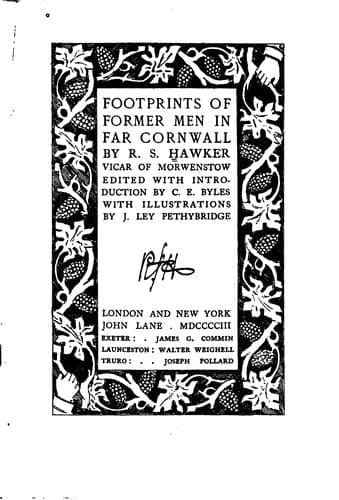
Footprints of Former Men in Far CornwallHawker, Robert Stephen
History
Footprints of Former Men in Far Cornwall
Hawker, Robert Stephen
Cornwall (England : County) -- History
A long account of Daniel Gumb is given in C. S. Gilbert’s “Historical
Survey of Cornwall” (vol. i. p. 166). When Gilbert visited the spot
in 1814, some remains of the habitation could still be traced, and on
the entrance, graven on a rock, was inscribed “D. Gumb, 1735.” (See
also Bond’s “Looe,” p. 203.) “Unfortunately they have now altogether
disappeared before the march of the barbarians known as quarrymen.”
The Cheesewring itself was claimed by Dr. Borlase as a Rock Idol, in
accordance with the quaint Druidical theories of the early antiquaries.
He says--
“From its having Rock-basons, from the uppermost Stone’s being
a Rocking-stone, from the well-poised structure and the great
elevation of this groupe [of rocks], I think we may truely reckon
it among the Rock-Deities, and that its tallness and just balance
might probably be intended to express the stateliness and justice
of the Supreme Being. Secondly, as the Rock-basons shew that it was
usual to get upon the top of this Karn, it might probably serve
for the Druid to harangue the Audience, pronounce decisions, and
foretell future Events.” (“Antiquities of Cornwall,” p. 174.)
The Rev. S. Baring-Gould gives in his “Book of the West” (vol. ii. p.
107) a curious instance of the persistency of tradition in connection
with a cairn near the Cheesewring, in which a gold cup was found a few
years ago.
“The story long told is that a party were hunting the wild boar
in Trewartha Marsh. Whenever a hunter came near the Cheesewring a
prophet--by whom an Archdruid is meant--who lived there received
him, seated in the stone chair, and offered him to drink out of
his golden goblet, and if there were as many hunters approach,
each drank, and the goblet was not emptied. Now on this day of
the boar-hunt one of those hunting vowed that he would drink the
cup dry. So he rode up to the rocks, and there saw the grey Druid
holding out his cup. The hunter took the goblet and drank till he
could drink no more, and he was so incensed at his failure that he
dashed what remained of the wine in the Druid’s face, and spurred
his horse to ride away with the cup. But the steed plunged over the
rocks and fell with his rider, who broke his neck, and as he still
clutched the cup he was buried with it.”
In Carew’s “Survey of Cornwall” (1602) occurs the following quaint
description of a logan-stone called Mainamber:--
“And a great rocke the same is, aduaunced upon some others of a
meaner size, with so equal a counterpeyze, that the push of a
finger, will sensibly moue it too and fro: but farther to remooue
it, the united forces of many shoulders are ouer-weake. Wherefore
the Cornish wonder-gatherer, thus descrybeth the same.
Public-domain text, read in full here on John Shaqi.
Reviews
Reviews
No reviews yet
Be the first to share your thoughts on this work.
Elsewhere in the archive
Join the Discussion
Join the discussion
Sign in to leave a comment or review.
Sign InorCreate an account