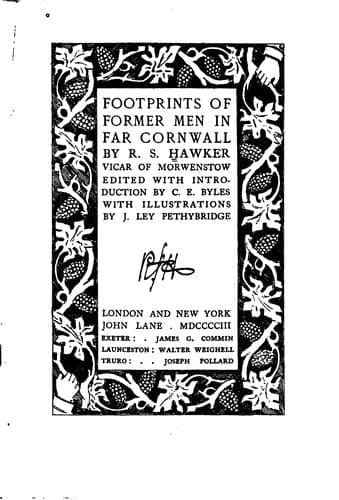
Footprints of Former Men in Far CornwallHawker, Robert Stephen
History
Footprints of Former Men in Far Cornwall
Hawker, Robert Stephen
Cornwall (England : County) -- History
(This Anthony Payne might be a son of the giant.)
The flagon which contained the giant’s allowance of liquor is mentioned
by Hawker in a private letter. He says--
“It is now safe in its usual place under my Escritoire.... The
Bottle itself is Antony Payne’s Allowance which used to be filled
for him every morning at Stowe, and as I measured it last week and
found it Six Quarts it ought to have sufficed him.”
From “Collectanea Cornubiensia,” by G. C. Boase (1890), we get the
following details as to the portrait of Anthony Payne. In August,
1888, the collection of antiquities at Trematon Castle, near Saltash,
was sold by auction on behalf of the executors of Admiral Tucker. One
of the lots was the portrait of Payne, and it was sold to a Plymouth
dealer for about £4. Through the good offices of Major Parkyn of Truro,
Mr. Harvey, on February 12th, 1889, purchased the picture from Skardon
& Sons of Plymouth, and presented it to the Royal Institution of
Cornwall at Truro.
[The Editor will be very glad to hear from any reader who may be able
to supply further information about Anthony Payne, his birth, life,
will, etc., that could be added to a future edition of this book.]
FOOTNOTE:
[163] See note on p. 118.
APPENDIX E_a_ (p. 109)
STOWE AND THE GRANVILLES
BY THE REV. PREBENDARY ROGER GRANVILLE
Hals states that Sir Thomas Grenvile (_temp._ Henry VI.) was the first
of the family who resided at Stowe, but Bishop Brantyngham licensed a
chapel there for Sir John de Grenvile on August 30th, 1386, and Henry
de Grenvile was buried at Kilkhampton about 1327, and the inquisition
after his death was taken there, and I believe that Henry de Grenvile
was the first to reside regularly at Stowe. His father, Bartholomew,
constantly signed deeds at Bideford, and Bishop Stapledon granted him
a license for the celebration of divine service “in capellâ suâ de
Bydeford.” So that I think it is safe to say that the Grenviles resided
at Stowe from at least the reign of Edward III.
The place was maintained in much style, I expect, in the time of Sir
Roger de Grenvile, “the great housekeeper,” famed far and wide for his
princely hospitality. Charles Kingsley’s description of the old house
in Elizabethan times is probably pretty accurate.
Public-domain text, read in full here on John Shaqi.
Reviews
Reviews
No reviews yet
Be the first to share your thoughts on this work.
Elsewhere in the archive
Join the Discussion
Join the discussion
Sign in to leave a comment or review.
Sign InorCreate an account