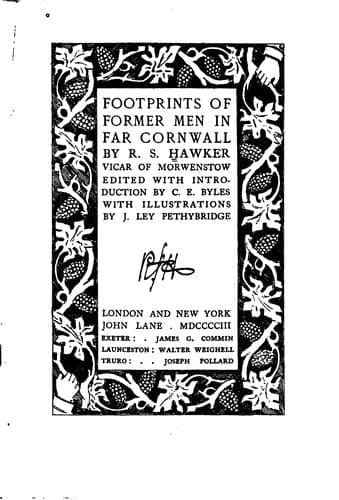
Footprints of Former Men in Far CornwallHawker, Robert Stephen
History
Footprints of Former Men in Far Cornwall
Hawker, Robert Stephen
Cornwall (England : County) -- History
For about two years he carried on his nefarious business of smuggling,
and stories are still told of the various methods he adopted of
outwitting the gauger. His chief cave was in the cliff at Sandhole,
but another is pointed out in Henstridge Wood, a couple of miles
inland. On one occasion, perhaps after Coppinger’s time, the caves
were watched so closely that the kegs of brandy which had been landed
were deposited at the bottom of the _zess_, as the pile of sheaves in
a barn is called, of an accommodating farmer. The gauger, who had his
suspicions, wished to search the zess, but the farmer was so willing to
help him in turning over the sheaves that his suspicions were allayed,
and he went away without finding any of the incriminating articles. On
another occasion the result was not so satisfactory for the farmer. On
the arrival of the gauger, he produced some empty kegs in order to give
his wife an opportunity of hiding a supply of valuable silks which had
been left in their care. The safest place she could think of in her
hurry was the oven, but she forgot that it had been heated for baking
a batch of bread. The result was that, although the gauger failed to
find them, they were burnt to ashes.
Mrs. Coppinger’s mother went to live with her other daughter and
son-in-law at Cross House in Harton. She was the owner of Galsham, and
retained possession of her husband’s money, and the tale runs that,
in order to obtain money from her, Coppinger, having been refused
admission, had been known to stand, with a pistol in each hand, on the
_lepping-stock_, or horse-block, in front of the house and threaten to
shoot any person who appeared at the door or any of the windows unless
the required sum was produced. It is even said that once, as he was
passing the house, he saw his brother-in-law, Randal, at the window,
and fired at him without provocation, but luckily missed his aim.
Mrs. Ann Hamlyn was buried on September 7th, 1800, after which date the
farm became the property of Mrs. Coppinger. Coppinger spent what he
could, but apparently became bankrupt, for in October, 1802, he was a
prisoner in the King’s Bench, in company with a Richard Copinger, who
is stated to have been a merchant in the island of Martinique. What
became of him afterwards does not seem to be known, but it is said
that he lived for many years at Barnstaple, in receipt of an allowance
from his wife. She herself went there to live out her days, and died
there on August 31st, 1833, at the age of eighty-two. She was buried
in the chancel of Hartland Church, in the grave of her friend, Alice
Western, and by the side of her mother. Coppinger’s name can still be
seen, inscribed in bold characters “D. H. Copinger” on a window-pane at
Galsham. Galsham is now the property of Major Kirkwood of Yeo Vale.
Public-domain text, read in full here on John Shaqi.
Reviews
Reviews
No reviews yet
Be the first to share your thoughts on this work.
Elsewhere in the archive
Join the Discussion
Join the discussion
Sign in to leave a comment or review.
Sign InorCreate an account