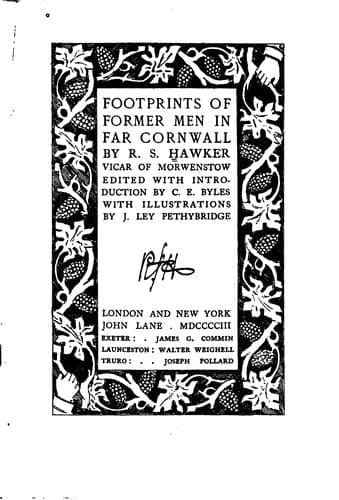
Footprints of Former Men in Far CornwallHawker, Robert Stephen
History
Footprints of Former Men in Far Cornwall
Hawker, Robert Stephen
Cornwall (England : County) -- History
Gumb appears to have united in his native character the simplicity of
an ancient hermit and the stern contempt of the solitary student for
the busy hum of men, with the brave resolution and independent energy
of mind which have won success and fame for some of our self-made sons
of science and skill. But his opportunities were few, and the severance
of his life and abode from contact with his fellow-men forbade that
access to the discoveries and researches of his kind which might have
rendered him, in other days, the Hugh Miller of the rocks, or the
Stephenson or Watt of a scientific solitude. He and his wife inhabited
their wedded cell for many years and long. The mother on her stony
couch gladdened her anxious husband with sons and daughters; but
she had the courage to brave her woman’s trials alone, for neither
midwife nor doctor were ever summoned to “the rock.” These, as may
well be imagined, were all literally educated at home; but only one
of their children--his name was John--appears to have inherited his
father’s habits or energy. He succeeded to the caverned home after
Daniel’s death, and when his mother had returned to her native village
to die also, the existence of John Gumb is casually seen recorded
as one of the skilful hewers of stone at the foot of Carradon. But
Daniel died “an old man full of days,” and he was carried after all
_ad plures_, and to the silent society of men, in the churchyard of
the parish wherein stood afar off his rocky home. He won and he still
deserves a nook of remembrance among the legendary sons of the west,
“the giants” of Keltic race, “the mighty men that were of old, the men
of renown.” His mind, though rough-hewn, like a block of his native
granite, must have been well balanced: resolute and firm reliance on a
man’s own resources, and disdain of external succour, have ever been
a signal of native genius. To be able to live alone, according to the
adage of an ancient sage, a man must be either an angel or a demon.
Gumb was neither, but a simple, strong-hearted, and intellectual man.
He had the “mens sana in corpore sano” of the poet’s aspiration. A
scenic taste and a mind “to enjoy the universe” he revealed in the
very choice of his abode. In utter scorn of the pent-up city, and
dislike for the reek of the multitude, he built like “the Kenite, his
nest in the rock;”[76] nor did he pitch his stony tent by chance, or
in a casual place in the wild. He chose and he fixed his home where
his eye could command and exult in a stretch of circumferent scenery
a hundred and fifty miles in surrounding extent. In the east, he
greeted the morning sun, as he mounted the rugged saddle of Dartmoor
and Exmoor for his daily career. To the west, Roche, the rock of the
ruined hermitage, lifted a bold and craggy crest to the sky, where long
centuries before another solitary of more ascetic mind lay, like the
patriarch on his pillow of granite, and reared a ladder to heaven by
the energy of nightly prayer.
Public-domain text, read in full here on John Shaqi.
Reviews
Reviews
No reviews yet
Be the first to share your thoughts on this work.
Elsewhere in the archive
Join the Discussion
Join the discussion
Sign in to leave a comment or review.
Sign InorCreate an account