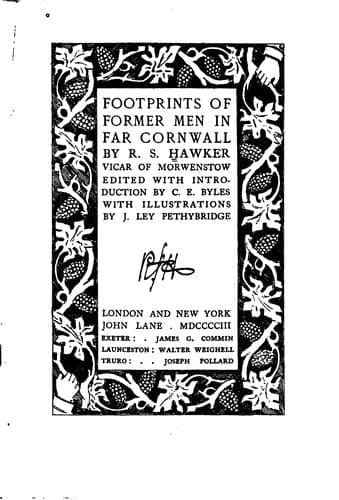
Footprints of Former Men in Far CornwallHawker, Robert Stephen
History
Footprints of Former Men in Far Cornwall
Hawker, Robert Stephen
Cornwall (England : County) -- History
Far, far away to the westward the haughty
sun of England went into the storied sea of Arthur and his knights,
and touched caressingly the heights of grim Dundagel with a lingering
halo of light. These were the visions that soothed and surrounded the
worker at his daily toil, and roused and strengthened the energies of
the self-sustaining man. The lessons of the legend of Daniel Gumb are
simple and earnest and strong. The words of supernatural wisdom might
be graven as an added superscription on his rock, “Whatsoever thou
doest, do it with all thine heart.” If thou be a man friendless and
alone, the slave of the hammer or the axe, and doomed to the sweat
of labour day by day till the night shall come that no man can work,
“aide-toi et Dieu t’aidera”--aid thyself and God will succour thee.
FOOTNOTES:
[64] From _All the Year Round_, vol. xv. pp. 206-210. 1866. See
Appendix D.
[65] Spelt “Routorr” in the lines quoted on p. 234. It seems more
natural to take the word as meaning “rough, or rugged, tor.” Hawker
spells it “Roughtor” on p. 124.
[66] Now called “Brown Willy.” See the lines quoted on p. 80.
[67] Compare the lines on Sir Lancelot in “The Quest of the Sangraal,”
and Hawker’s note--
“Ah me! that logan of the rocky hills,
Pillar’d in storm, calm in the rush of war,
Shook at the light touch of his lady’s hand!”
The ballad on “The Doom Well of St. Madron” records a similar test of
innocence. For Carew’s description of a logan-rock, see end of Appendix
D.
[68] See Appendix D_a_.
[69]
“On one side lay the Ocean, and on one
Lay a great water, and the moon was full.”
[70] William Cookworthy (1705-1780) started life as a small druggist in
Nut Street, Plymouth. He had been educated by the Society of Friends,
and at thirty-one he retired from trade, became a Quaker minister, and
continued so for twenty-five years. About 1758, having discovered a
new process of making porcelain, he set up a manufactory at Plymouth,
which was after his death transferred to Bristol, and thence to the
Potteries. “Cookworthy is said to have been a believer in the _dowsing_
or divining-rod for discovering mineral veins, and we learn that he
became a disciple of Swedenborg.... As a lover of science he was much
appreciated, as is proved by the fact that Sir Joseph Banks, Dr.
Solander, and Captain Cook, dined with him at Plymouth before their
voyage round the world” (“Dictionary of National Biography”). His
duties led him to travel about the mining districts of Cornwall, and
he was a great friend of Nancarrow of Godolphin, a superintendent of
mines. It would be on these journeys, no doubt, that he came across
Daniel Gumb. Cookworthy died on October 16, 1780, aged 76.
[71]
“On many a cairn’s grey pyramid,
Where urns of mighty chiefs lie hid.”
_Lay of the Last Minstrel._
[72] It was not Agag, but Og, the king of Bashan, who had the bedstead
of iron. See Deuteronomy iii. 11.
Public-domain text, read in full here on John Shaqi.
Reviews
Reviews
No reviews yet
Be the first to share your thoughts on this work.
Elsewhere in the archive
Join the Discussion
Join the discussion
Sign in to leave a comment or review.
Sign InorCreate an account