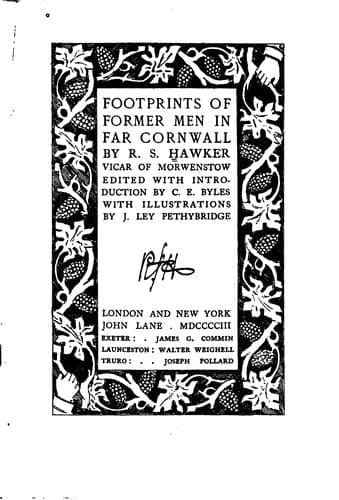
Footprints of Former Men in Far CornwallHawker, Robert Stephen
History
Footprints of Former Men in Far Cornwall
Hawker, Robert Stephen
Cornwall (England : County) -- History
But a great and sudden change was about to come over the happy halls
of Stowe. The king and his Parliament were at fatal strife; and there
could be but one place in the land for the true-hearted and chivalrous
Sir Beville, and that was at his royal master’s side.[82] The
well-known rallying cry went through the hills and valleys of Cornwall,
“Granville’s up!” and the hearts and hands of many a noble knight and
man-at-arms turned towards old Stowe. Mounted messengers rode to and
fro. Strange and stalwart forms arrived to claim a place in the ranks.
Retainers were enrolled day and night; and the smooth sward of the
bowling-green and the Fawn’s Paddock were dinted by the hoofs of horses
and the tread of serried men. Foremost among these scenes we find, as
body-guard of his master, the bulky form of Antony Payne. He marshalled
and manœuvred the rude levies from the western mines, “the underground
men.” He served out arms and rations, and established order, by the
mere terror of his presence and strength, among the wild and mixed
multitude that gathered “for the king and land.”
Instead of the glad and hospitable scenery of former times, Stowe
became in those days like a garrison surrounded by a camp. At last,
one day tidings arrived that the battalions of the Parliament, led by
Lord Stamford, were on their way northwards, and not many miles off. A
picked and goodly company marched forth from the avenue of Stowe, and
among them Payne, on his Cornish cob Samson, of pure Guinhilly breed.
The next day, eight miles towards the south, the battle of Stratton
Hill was fought and won by the royal troops. The Earl of Stamford
was repulsed, and fled, bequeathing, by a strange mischance, his own
name, though the defeated commander, to the field of battle. It is
called to this day Stamford Hill.[83] Sir Beville returned that night
to Stowe, but his Giant remained with some other soldiers to bury the
dead. He had caused certain large trenches to be laid open, each to
hold ten bodies side by side. There he and his followers carried in the
slain. On one occasion they had laid down nine corpses, and Payne was
bringing in another, tucked under his arm, like one of “the kittens”
of his schoolboy days, when all at once the supposed dead man was heard
pleading earnestly with him, and expostulating, “Surely you wouldn’t
bury me, Mr. Payne, before I am dead?” “I tell thee, man,” was the grim
reply, “our trench was dug for ten, and there’s nine in already; you
must take your place.” “But I bean’t dead, I say; I haven’t done living
yet; be massyful, Mr. Payne--don’t ye hurry a poor fellow into the
earth before his time.” “I won’t hurry thee: I mean to put thee down
quietly and cover thee up, and then thee canst die at thy leisure.”
Payne’s purpose, however, was kinder than his speech. He carried his
suppliant carefully to his own cottage not far off, and charged his
wife to stanch, if possible, her husband’s rebellious blood. The man
Public-domain text, read in full here on John Shaqi.
Reviews
Reviews
No reviews yet
Be the first to share your thoughts on this work.
Elsewhere in the archive
Join the Discussion
Join the discussion
Sign in to leave a comment or review.
Sign InorCreate an account