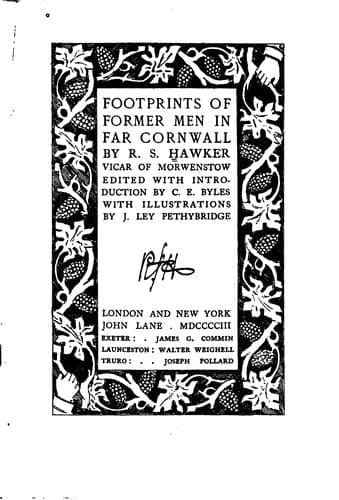
Footprints of Former Men in Far CornwallHawker, Robert Stephen
History
Footprints of Former Men in Far Cornwall
Hawker, Robert Stephen
Cornwall (England : County) -- History
So for many years Payne continued to fulfil his various duties as Sir
Beville’s chief retainer at Stowe. He it was who was the leader and
the authority in every masculine sport. He embowelled and flayed the
hunted deer, and carried the carcass on his own shoulders to the Hall,
where he received as his guerdon the horns and the hide. The antlers,
cleansed and polished, were hoisted as a trophy on the panelled wall;
and the skins, dressed and prepared, were shaped into a jerkin for
his goodly chest. It took the spoils of three full-grown red deer to
make the garment complete. His master’s sons and their companions, the
very pride of the West, who were housed and instructed at Stowe, when
released from their graver studies, were under his especial charge.
He taught them to shoot, and fish, and to handle arms. Tilt-yard and
bowling-green, and the hurler’s ground, can still be identified at
Stowe. In the latter, the poising-place and the mark survive, and a
rough block of graywacke is called to this day “Payne’s cast;” it lies
full ten paces beyond the reach whereat the ordinary players could “put
the stone.”
It is said that one Christmas-eve the fire languished in the Hall.
A boy with an ass had been sent to the woodland for logs, and the
driver loitered on his homeward way. Lady Grace lost patience, and
was displeased. All at once a sudden outcry was heard at the gate,
and Sir Beville’s Giant appeared with the loaded animal on his mighty
back. He threw down his burden in triumph at the hearth-side, shouting
merrily, “Ass and fardel! ass and fardel for my lady’s Yule!” Another
time he strode along the path from Kilkhampton village to Stowe with
a bacon-hog of three hundredweight thrown across his shoulders, and
merely because a taunting butcher had doubted his strength for the
feat. Among the excellences of Sir Beville’s Giant, it is told of him
that he was by no means clumsy or uncouth, as men of unusual size
sometimes are, but as nimble and elastic, and as capable of swift and
dexterous movement, as a light and muscular man. Added to this, his
was a strong and acute intellect; so happy also in his language, and
of such a ready wit, that he was called by a writer[81] of the last
century, from his resemblance, in these points only, to Shakespeare’s
knight, “the Falstaff of the West.”
Public-domain text, read in full here on John Shaqi.
Reviews
Reviews
No reviews yet
Be the first to share your thoughts on this work.
Elsewhere in the archive
Join the Discussion
Join the discussion
Sign in to leave a comment or review.
Sign InorCreate an account