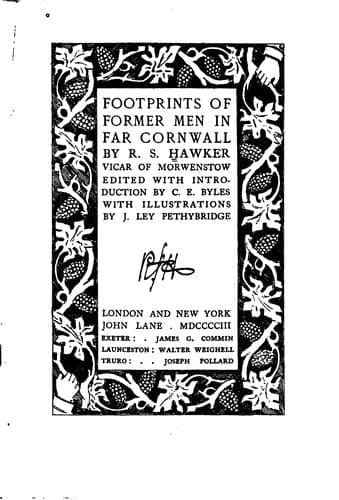
Footprints of Former Men in Far CornwallHawker, Robert Stephen
History
Footprints of Former Men in Far Cornwall
Hawker, Robert Stephen
Cornwall (England : County) -- History
beheaded, a sub-officer of Payne’s own rank had ordered a calf’s head
to be served up in a “William-and-Mary dish.” This, in those days of
new devotion to the house of Hanover, was a coarse and common annual
mockery of the beheaded king; and delf, with the faces of these two
sovereigns for ornament, was a valued ware (the writer has one large
dish). When Payne entered the room, his comrades pointed out to him the
insulting and practical jest--to him, too, most offensive, for he was
a Stuart man. With a ready and indignant gesture he threw out of the
window the symbolic platter and its contents.
[Illustration: FIG. 3
ANTONY PAYNE’S FLAGON (P. 120)]
A fierce quarrel ensued and a challenge, and at break of day Payne
and his antagonist fought with swords on the ramparts. After a strong
contest--for the offender was a master of his weapon--Payne ran his
adversary through the sword-arm and disabled him. He is said to have
accompanied the successful thrust with the taunting shout, “There’s
sauce for thy calf’s head!” When the strong man at last began to bow
himself down at the approach of one stronger than he, the Giant of
Stowe obtained leave to retire. He returned to Stratton, his native
place, and found shelter and repose in the very house and chamber
wherein he was born.
After his death, neither the door nor the stairs would afford egress
for the large and coffined corpse. The joists had to be sawn through,
and the floor lowered with rope and pulley, to enable the Giant to pass
out towards his mighty grave. Relays of strong bier-men carried him
to his rest, and the bells of the tower, by his own express desire,
“chimed him home.” He was buried outside the southern wall of Stratton
church.[89] When the writer was a boy, the sexton one day broke, by
accident, through the side wall of a vast but empty sepulchre. Many
went to see the sight, and there, marked by a stone in the wall, was a
vault, like the tomb of the Anakim, large enough in these days for the
interment of three or four of our degenerate dead. But it was empty,
desolate, and bare. No mammoth bones nor mysterious relics of the
unknown dead. A massive heap of silent dust!
FOOTNOTES:
[77] From _All the Year Round_, vol. xvi. pp. 247-249. 1866. See
Appendix E.
[78] See Appendix B.
[79] Compare Hawker’s poem, “Sir Beville--the Gate Song of Stowe.” See
also Appendix E_a_.
[80] It is said locally that Antony’s stocking would hold a peck of
wheat.
[81] C. S. Gilbert in his “History of Cornwall.”
[82]
“Ride! ride! with red spur, there is death in delay,
’Tis a race for dear life with the devil;
If dark Cromwell prevail, and the king must give way,
This earth is no place for Sir Beville.”
_The Gate Song of Stowe._
[83] There is a description of this battle in Q’s novel, “The Splendid
Spur,” one of the most vivid and stirring battle pictures in modern
fiction.
Public-domain text, read in full here on John Shaqi.
Reviews
Reviews
No reviews yet
Be the first to share your thoughts on this work.
Elsewhere in the archive
Join the Discussion
Join the discussion
Sign in to leave a comment or review.
Sign InorCreate an account