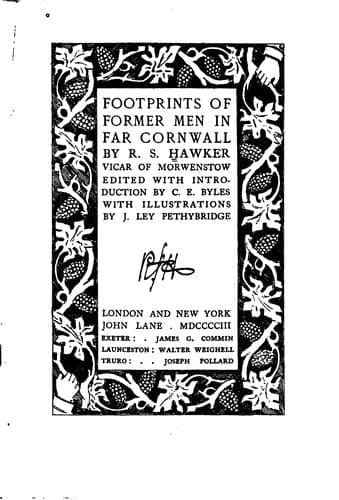
Footprints of Former Men in Far CornwallHawker, Robert Stephen
History
Footprints of Former Men in Far Cornwall
Hawker, Robert Stephen
Cornwall (England : County) -- History
This gentle desire so uttered--her strong and grateful feelings
towards the master who had taken her, as she expressed it in her
rural speech, lean from the moor, and fed her, so that her very bones
belonged to him--her happy home, and the power she would acquire to
make the latter days in the cottage at Wike St. Marie prosperous
and calm,--all these impulses flocked into Thomasine’s heart, and
controlled for the time even the remembrance of Cousin John. That poor
young man, when the tidings came that she was about to become her
master’s wedded wife, suddenly disappeared, and for a while the place
of his retreat was unknown; but it afterwards transpired that he had
crossed the moor to a “house of religious men,” called the White Monks
of St. Cleer, and pleaded for reception there as a needy novice of the
gate. His earnest entreaties had prevailed; and six months after his
first love, and his last, had put on her silks as a city dame, and
begun her rule as the mistress of a goodly house in London, her cousin
had taken the vows of his novitiate, and received the first tonsure of
St. John.
Her married life did not, however, long endure. Three years after the
master became the husband, he took the “plague sore,” and died. They
were childless; but he bequeathed “all his goods and chattel property,
and his well-furnished mansion, to his dear wife Thomasine Bonaventure,
now Bunsby;” and the maid of the moor became one of the wealthy widows
of London city. Among the MSS. which still survive, there is a letter
which announces the event of her husband’s death and bequest, and then
proceeds to notify her solemn donation, as a year’s-mind of Master
Bunsby, of ten marks to the Reeve of Wike St. Marie, “to the intent
that he shall cause skeelful masons to build a bridge at the Ford of
Green-a-Moor: yea, and with stout stonework well laid; and see,” she
wrote, “that they do no harm to that tree which standeth fast by the
brook, neither dispoyle they the rushes and plants that grow thereby;
for there did I passe many goodly hours when I was a simple mayde,
and there did I first see the kind face of a fathful frend.” But in
another missive to her mother, about the same date, there is a touch of
tenderness which shows that her woman’s nature survived all changes,
and was strong within her still. She writes: “I know that Cousin John
is engaged to the monks of St. Cleer. Hath he been shorn, as they do
call it, for the second time? Inquire, I beseech, if he seeketh to
dispart from that cell? And will red gold help him away? I am prospered
in pouch and coffer, and he need not shame to be indebted unto me,
that owe so much to him.” But this frank and kindly effort--“the
late remorse of love”--did not avail. John had broken the last link
that bound him to the world, and was lost to love and her. Reckless
thenceforward, therefore, if not fancy-free, and it may be somewhat
schooled by the habits and associations of city life, she did not wear
the widow’s wimple long.
Public-domain text, read in full here on John Shaqi.
Reviews
Reviews
No reviews yet
Be the first to share your thoughts on this work.
Elsewhere in the archive
Join the Discussion
Join the discussion
Sign in to leave a comment or review.
Sign InorCreate an account