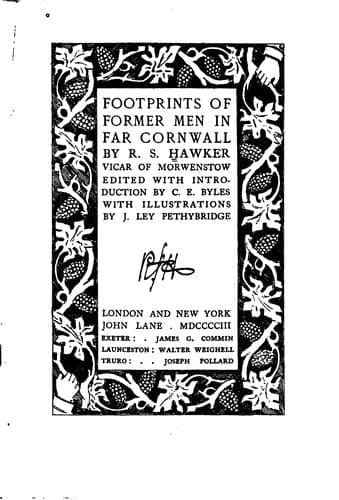
Footprints of Former Men in Far CornwallHawker, Robert Stephen
History
Footprints of Former Men in Far Cornwall
Hawker, Robert Stephen
Cornwall (England : County) -- History
[100] The remains of this old building have been embodied in some
cottages. The doorway shown in the illustration forms the front door of
one of these. The other is occupied by the Cornwall County Police, and
the unsuspecting pilgrim who rambles round without permission is liable
to be startled by the gruff remark, “You’m trespassing!” Thus are we
recalled from “the baseless fabric” of the past to the stern realities
of the living present.
[101] Hawker gives a romantic turn of his own to this part of the story.
THE BOTATHEN GHOST[102]
There was something very painful and peculiar in the position of the
clergy in the west of England throughout the seventeenth century. The
Church of those days was in a transitory state, and her ministers,
like her formularies, embodied a strange mixture of the old belief
with the new interpretation. Their wide severance also from the great
metropolis of life and manners, the city of London (which in those
times was civilised England, much as the Paris of our own day is
France), divested the Cornish clergy in particular of all personal
access to the masterminds of their age and body. Then, too, the barrier
interposed by the rude rough roads of their country, and by their
abode in wilds that were almost inaccessible, rendered the existence
of a bishop rather a doctrine suggested to their belief than a fact
revealed to the actual vision of each in his generation. Hence it
came to pass that the Cornish clergyman, insulated within his own
limited sphere, often without even the presence of a country squire
(and unchecked by the influence of the Fourth Estate--for until the
beginning of this nineteenth century, _Flindell’s Weekly Miscellany_
distributed from house to house from the pannier of a mule, was the
only light of the West), became developed about middle life into an
original mind and man, sole and absolute within his parish boundary,
eccentric when compared with his brethren in civilised regions, and
yet, in German phrase, “a whole and seldom man” in his dominion of
souls. He was “the parson,” in canonical phrase--that is to say, The
Person, the somebody of consequence among his own people. These men
were not, however, smoothed down into a monotonous aspect of life and
manners by this remote and secluded existence. They imbibed, each in
his own peculiar circle, the hue of surrounding objects, and were
tinged into distinctive colouring and character by many a contrast
of scenery and people.[103] There was the “light of other days,”
the curate by the sea-shore, who professed to check the turbulence
of the “smugglers’ landing” by his presence on the sands, and who
“held the lantern” for the guidance of his flock when the nights were
dark, as the only proper ecclesiastical part he could take in the
proceedings.[104] He was soothed and silenced by the gift of a keg
of hollands or a chest of tea. There was the merry minister of the
mines, whose cure was honeycombed by the underground men. He must needs
Public-domain text, read in full here on John Shaqi.
Reviews
Reviews
No reviews yet
Be the first to share your thoughts on this work.
Elsewhere in the archive
Join the Discussion
Join the discussion
Sign in to leave a comment or review.
Sign InorCreate an account