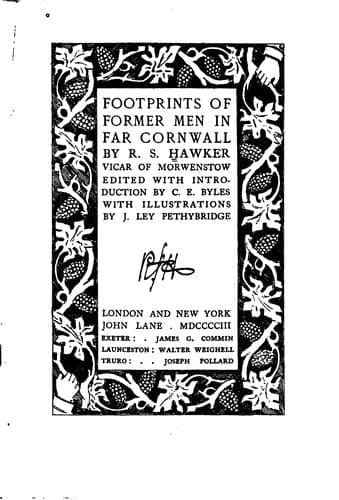
Footprints of Former Men in Far CornwallHawker, Robert Stephen
History
Footprints of Former Men in Far Cornwall
Hawker, Robert Stephen
Cornwall (England : County) -- History
“The Place,” as it was called, of Botathen, where old Mr. Bligh
resided, was a low-roofed gabled manor-house of the fifteenth century,
walled and mullioned, and with clustered chimneys of dark-grey stone
from the neighbouring quarries of Ventor-gan. The mansion was flanked
by a pleasaunce or enclosure in one space, of garden and lawn, and
it was surrounded by a solemn grove of stag-horned trees. It had the
sombre aspect of age and of solitude, and looked the very scene of
strange and supernatural events. A legend might well belong to every
gloomy glade around, and there must surely be a haunted room somewhere
within its walls. Hither, according to his appointment, on the morrow,
Parson Rudall betook himself. Another clergyman, as it appeared, had
been invited to meet him, who, very soon after his arrival, proposed
a walk together in the pleasaunce, on the pretext of showing him, as
a stranger, the walks and trees, until the dinner-bell should strike.
There, with much prolixity, and with many a solemn pause, his brother
minister proceeded to “unfold the mystery.”
“A singular infelicity,” he declared, “had befallen young Master
Bligh, once the hopeful heir of his parents and of the lands of
Botathen. Whereas he had been from childhood a blithe and merry
boy, ‘the gladness,’ like Isaac of old, of his father’s age, he had
suddenly, and of late, become morose and silent--nay, even austere and
stern--dwelling apart, always solemn, often in tears. The lad had at
first repulsed all questions as to the origin of this great change, but
of late he had yielded to the importunate researches of his parents,
and had disclosed the secret cause. It appeared that he resorted,
every day, by a pathway across the fields, to this very clergyman’s
house, who had charge of his education, and grounded him in the studies
suitable to his age. In the course of his daily walk he had to pass a
certain heath or down where the road wound along through tall blocks of
granite with open spaces of grassy sward between. There in a certain
spot, and always in one and the same place, the lad declared that he
encountered, every day, a woman with a pale and troubled face, clothed
in a long loose garment of frieze, with one hand always stretched
forth, and the other pressed against her side. Her name, he said, was
Dorothy Dinglet,[109] for he had known her well from his childhood, and
she often used to come to his parents’ house; but that which troubled
him was, that she had now been dead three years, and he himself had
been with the neighbours at her burial; so that, as the youth alleged,
with great simplicity, since he had seen her body laid in the grave,
this that he saw every day must needs be her soul or ghost. ‘Questioned
again and again,’ said the clergyman, ‘he never contradicts himself;
but he relates the same and the simple tale as a thing that cannot be
gainsaid. Indeed, the lad’s observance is keen and calm for a boy of
his age.
Public-domain text, read in full here on John Shaqi.
Reviews
Reviews
No reviews yet
Be the first to share your thoughts on this work.
Elsewhere in the archive
Join the Discussion
Join the discussion
Sign in to leave a comment or review.
Sign InorCreate an account