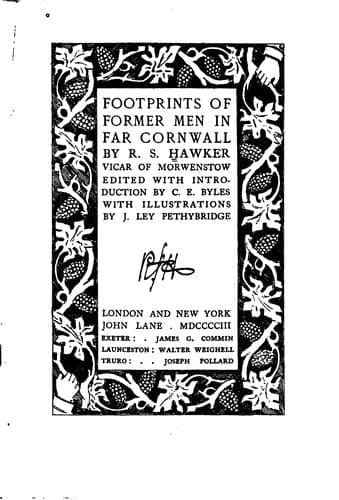
Footprints of Former Men in Far CornwallHawker, Robert Stephen
History
Footprints of Former Men in Far Cornwall
Hawker, Robert Stephen
Cornwall (England : County) -- History
ancient transgressor, Mr. B. Great horror and remorse; entire atonement
and penance; whatsoever I enjoin; full acknowledgment before pardon.
_“January 13, 1665._--At sunrise I was again in the field. She came
in at once, and, as it seemed, with freedom. Inquired if she knew my
thoughts, and what I was going to relate? Answered, ‘Nay, we only know
what we perceive and hear; we cannot see the heart.’ Then I rehearsed
the penitent words of the man she had come up to denounce, and the
satisfaction he would perform. Then said she, ‘Peace in our midst.’
I went through the proper forms of dismissal, and fulfilled all as
it was set down and written in my memoranda; and then, with certain
fixed rites, I did dismiss that troubled ghost, until she peacefully
withdrew, gliding towards the west. Neither did she ever afterward
appear, but was allayed until she shall come in her second flesh to the
valley of Armageddon on the last day.”
These quaint and curious details from the “diurnal” of a simple-hearted
clergyman of the seventeenth century appear to betoken his
personal persuasion of the truth of what he saw and said, although
the statements are strongly tinged with what some may term the
superstition, and others the excessive belief, of those times. It is a
singular fact, however, that the canon which authorises exorcism under
episcopal licence, is still a part of the ecclesiastical law of the
Anglican Church, although it might have a singular effect on the nerves
of certain of our bishops[115] if their clergy were to resort to them
for the faculty which Parson Rudall obtained. The general facts stated
in his diary are to this day matters of belief in that neighbourhood;
and it has been always accounted a strong proof of the veracity of the
Parson and the Ghost, that the plague, fatal to so many thousands, did
break out in London at the close of that very year. We may well excuse
a triumphant entry, on a subsequent page of the “diurnal,” with the
date of July 10, 1665: “How sorely must the infidels and heretics of
this generation be dismayed when they know that this Black Death, which
is now swallowing its thousands in the streets of the great city, was
foretold six months agone, under the exorcisms of a country minister,
by a visible and suppliant ghost! And what pleasures and improvements
do such deny themselves who scorn and avoid all opportunity of
intercourse with souls separate, and the spirits, glad and sorrowful,
which inhabit the unseen world!”
FOOTNOTES:
[102] From _All the Year Round_, vol. xvii. pp. 501-504. 1867. The story
occurs in C. S. Gilbert’s “Historical Survey of Cornwall,” in Mrs.
Bray’s “Trelawny of Trelawn,” and in “Histories of Launceston,” by R.
and O. B. Peter.
[103] All this is singularly applicable to Hawker himself.
[104] See p. 45.
Public-domain text, read in full here on John Shaqi.
Reviews
Reviews
No reviews yet
Be the first to share your thoughts on this work.
Elsewhere in the archive
Join the Discussion
Join the discussion
Sign in to leave a comment or review.
Sign InorCreate an account