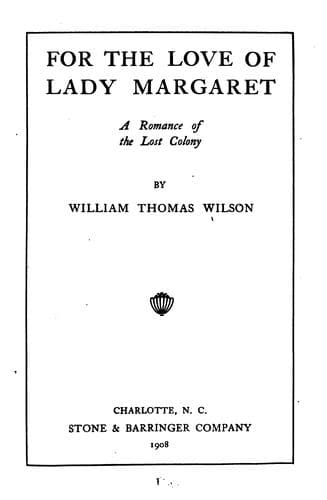
For the Love of Lady Margaret: A Romance of the Lost ColonyWilson, William Thomas
General
For the Love of Lady Margaret: A Romance of the Lost Colony
Wilson, William Thomas
Roanoke Colony -- Fiction
We finally reached a little grassy hillock, and here the Indian paused.
With a wave of his hand he said:
"Will the Eagle rest here to-night?"
"Yes, my brother," I answered. "It is a fair spot, and here we will
stop until the morrow," and turning to the waiting men, I bade them
throw aside their baggage and rest.
Posting two sentries, I cast myself beside the Indian upon the grass.
It had been long since I had taken such a jaunt as this, and my limbs
ached from the unaccustomed exertion. The scent of the roasting venison
floated up to my nostrils from where the men had lighted a little
fire, which, by the direction of the Indian, they had kindled in a low
depression, so that it could not be seen by any prowling wanderer. The
firelight played upon the rough, bronzed faces of the men, and flashed
from their swords and breastplates, flickering upon the fierce features
of Manteo as he lay in his paint and feathers by my side, and upon my
face as I watched the men.
Suddenly the Indian raised his hand and pointed to the west.
"Look, my brother," he said.
I followed his outstretched finger; there, far away from the depths of
the forest, twinkled a tiny light like a star, one moment it might be
seen, and then it would be lost for an instant--then lo! as we looked
it would rise again.
"What is it, Manteo?" I asked in surprise.
"'Tis the signal fire of some scout," he answered. "It may be that the
natives have discovered that we are advancing into their country, and
even now they send the news to their friends."
Only the cry of some wild beast of prey echoed from the forest, and
anon the mournful call of some strange bird. We were alone, cut off
from all civilization and the world. I looked around me; of how many
bloody struggles could not these dark glades tell, could they but
speak; how many black and gloomy secrets of war and massacre. They had
looked down for countless ages upon the roaming red man, and the wild
animals of the forest, but never until now had they been trodden by the
foot of civilized man.
The cheery shout of the men floated up to where we lay. They called
us to our evening meal, and descending the little hillock, we joined
them in their fierce attack upon the smoking venison. After we had
eaten our fill, Manteo and myself, lighting our pipes, strode out in
the moonlight; below us trickled a little spring, its waters clear as
crystal, and I followed the Indian down to drink of its pure waters.
He was bending over the moist earth in front of the spring, looking
down at the ground intently.
"What is it, Manteo?" I asked, noticing his strange conduct.
"It is the foot of some white squaw," he answered arising. "Let my
brother look."
Public-domain text, read in full here on John Shaqi.
Reviews
Reviews
No reviews yet
Be the first to share your thoughts on this work.
Elsewhere in the archive
Join the Discussion
Join the discussion
Sign in to leave a comment or review.
Sign InorCreate an account