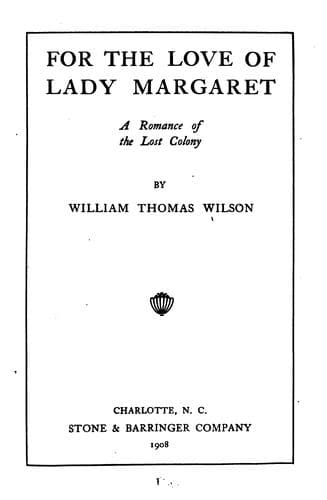
For the Love of Lady Margaret: A Romance of the Lost ColonyWilson, William Thomas
General
For the Love of Lady Margaret: A Romance of the Lost Colony
Wilson, William Thomas
Roanoke Colony -- Fiction
And now on the fifteenth day of our departure from Roanoke Island we
still followed after them. Manteo, who glided in front, was striding
along, his eyes as usual upon the ground. I following him, was
wondering for the one hundreth time whether it was possible that this
could be Margaret, and if so how she came there, and who were her
companions; Dunraven of course, and the pale one, as the Indian called
Marsden. Who was the third white man? It might be DeNortier, and so
musing I bumped suddenly into the Indian, who had halted, and almost
threw him sprawling upon the ground.
"Hush!" he whispered, his finger upraised.
I stopped, as did the man behind me, and listened. Far away I could
hear the deep regular strokes of an ax; plainly someone was chopping,
but who in this wilderness??
"Wait here," muttered Manteo. "I will see who it is that cuts so
loudly," and with that he glided silently away, across the little open
glade in front of us, and into the trees upon the other side.
A few minutes passed, and then he came back again as silently as he had
left.
"Come," he said, and he turned and retraced his steps whence he had
come.
We followed him for perhaps ten minutes, and then emerging from the
trees, we came full upon a strange Indian. Bow in hand, he sat quietly
by the side of a charred tree, which he had been fashioning into a
canoe with a stone tomahawk, after burning out the heart of the tree.
He arose gravely as I approached, and stood looking at me, his fierce
eyes scanning my face searchingly.
"This is the great white chief, the Eagle," said Manteo to the other
brave. "Tell him what thou hast seen."
The Indian answered, speaking in what appeared to be a dialect of
the same tongue that Manteo spoke, and though it differed in some
respects, I could yet manage to understand what he said.
"The sun has stood still twice, since Occom beheld a strange sight, for
as he sat in this same spot, he heard the sound of feet approaching,
and hiding himself, there passed by three pale men, and a squaw more
lovely than the harvest moon. They had with them Tetto, one of the
Tuscaroras, and as Occom looked they disappeared on down the trail, and
I saw them no more."
"What manner of men were they, my brother?" I asked.
"The chief was tall, with dark hair, and his face was as the stone; the
look upon it was like the hawk when he wheels to strike his prey."
It was Dunraven without a doubt, the Indian had described him well. But
who were his companions?
"And what of the others?" I continued. "Did the eye of Occom behold the
others?"
"Occom saw them," he answered. "The one who walked behind the chief was
as the pale moon, when afraid it shrinks behind the clouds, and when
the chief spoke to him harshly, he drew back in fear; he is a squaw and
should till the soil with them."
"And what of the third?--what of him, Occom?"
Public-domain text, read in full here on John Shaqi.
Reviews
Reviews
No reviews yet
Be the first to share your thoughts on this work.
Elsewhere in the archive
Join the Discussion
Join the discussion
Sign in to leave a comment or review.
Sign InorCreate an account