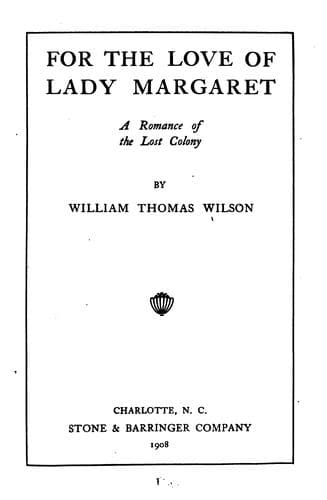
For the Love of Lady Margaret: A Romance of the Lost ColonyWilson, William Thomas
General
For the Love of Lady Margaret: A Romance of the Lost Colony
Wilson, William Thomas
Roanoke Colony -- Fiction
The old chieftain, Windango, adored his bright young daughter, and
she twisted him about her fingers, as the saying goes, until he would
believe that black was white if she but said so. She had been brought
up free from all the toil that had bowed the hearts and bent the backs
of her companions, and while they were fast becoming withered and
faded, she was strong and graceful, a veritable wild Diana. She could
follow the chase as well as any brave, and strike down with her arrows
the wild deer. Often had I seen her return from a day's hunt fresh and
smiling, while behind her there lagged some warrior worn and footsore.
But even the old chief had begun to admonish his daughter to give ear
to the soft sighs of the young braves, and become the squaw of some
warrior. She was long past the age when her companions had wedded. Why
did she still remain alone? Here was Chawanook, who would some day be
a great chief. Why not go into his wigwam and cook his venison? It was
of this that Winona spoke as she finished one moccasin, and laying it
aside, began to embroider the other with the bear claws.
"Do the maidens beyond the seas go into the lodges of the braves so
soon?" she asked, with a bright smile at me.
"Some," I answered, smiling gently at her question. "Many of them do
not go at all."
She broke into a low clear laugh.
"Would that I dared to tell my father that, but he would tear my head
from my shoulders, did I dare to hint such a thing. He wishes me to
become the squaw of Chawanook; to slave and toil for him--and he ugly
and awkward," and she frowned, her eyes still upon me, as though she
wished to draw me out.
"Why dost thou not listen to Chawanook?" I answered. "He is a brave
young warrior, and will some day become a chief. That he would be kind
to thee, I doubt not."
She laid down the moccasin and looked at me intently, the smile gone
from her face.
"And thou wouldst counsel that," she said in a low voice. "I thought
that thou wert the friend of Winona."
"Even so," I replied; "and it is because I think much of Winona that I
speak thus."
"Dost some fair maid await across the great sea for the Eagle?" she
asked eagerly, changing the conversation with the artfulness of a woman.
I shook my head. "No," I replied sadly, "no one waits for the Eagle--he
is alone."
She still sat opposite looking at me, the half-finished moccasin beside
her.
"The squaw of the Eagle is in the forest above the head of the river,"
she said. "Is that why the Eagle walks abroad in the moonlight, when
all are slumbering, and sighs to himself until day? Does he love the
fair young maid, who is in the hands of his foes?"
"The squaw belongs to one of the Eagle's friends," I replied gently,
for the girl did not know that she touched a raw and bleeding wound.
"He seeks her for one whom he loves as a brother."
The girl looked at me; plainly she was debating something in her mind.
Finally she spoke hesitatingly, and bending forward she whispered in a
low voice:
Public-domain text, read in full here on John Shaqi.
Reviews
Reviews
No reviews yet
Be the first to share your thoughts on this work.
Elsewhere in the archive
Join the Discussion
Join the discussion
Sign in to leave a comment or review.
Sign InorCreate an account