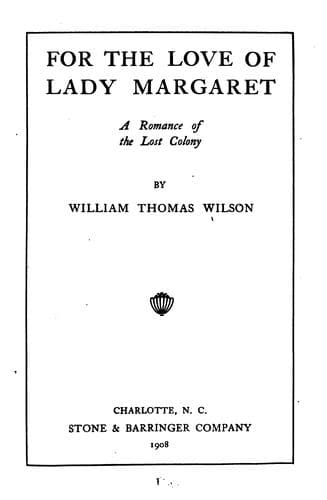
For the Love of Lady Margaret: A Romance of the Lost ColonyWilson, William Thomas
General
For the Love of Lady Margaret: A Romance of the Lost Colony
Wilson, William Thomas
Roanoke Colony -- Fiction
"Wouldst thou know what the chief has said of thee, Lady Margaret?" I
asked, a twinkle in my eye, for the chief had spoken in his own tongue.
Although he understood the English language, yet he would never express
himself in it, but would always talk to me in his own soft speech.
"What is it?" she asked, a faint smile upon her face as she noticed my
glee. "Nothing bad, I hope."
"He says that thou art more lovely than the dawn," I answered, wisely
judging that it would be better to suppress the latter part of his
remark.
The color deepened in her cheeks.
"Since when hast thou taught the very savages to turn a compliment?"
she said. "Truly, sir, thou hast not labored in vain."
"They know no better than to tell the truth," I answered, a smile upon
my face. "'Tis from the heart, and not from the lips as in London."
She made no answer, but turning her head looked out upon the dark
river, as its waters glistened and sparkled in the moonlight. And I
watched her lovely profile as she sat thus.
"It is beautiful, is it not?" she said softly.
"Very beautiful," I answered, as I still gazed at her. I was thinking
of her face, and if I but dared to lean over and press my lips to that
soft cheek, which so lately had lain against my shoulder.
She stamped her little foot.
"Where are thy wits?" she said. "Thou lookest off as though in a dream,
and I venture to say that thou knowest not one word that I have said."
"Margaret," I answered, "I would know one thing. The priest once showed
me a paper in thy hand and stamped with thy crest, in which thou didst
say that thou lovest Dunraven, and would be his wife. It almost shook
my faith in God and man, that thou, whom I believed so pure and noble,
shouldst love one so black as he. I had thought to ask thee that night
in the prison, but it slipped my mind. Tell me, didst thou write such a
note as this?"
"And thou thinkest that I would do such a thing as that?" she answered,
with a look of reproach. "For shame, Sir Thomas! Have I ever in my
whole life given thee cause to think thus of me?"
"Forgive me," I replied. "But the note was in thy handwriting, upon thy
paper, and scented with thy perfume."
"Thou mightst have known better," she answered gravely, and she looked
out again upon the river.
"Oh, man," she cried in scorn, "canst thou never believe that a woman
cares naught but for wealth and fame; that she plans for naught but
rank and position, and that her mind is ever filled with thoughts of
conquest?"
"I know of one lady who, I think is all that mortal should be," I
answered; "whose pure soul can hold no unworthy thought."
"And who pray may this person be? Fain would I know such a one," and
she looked up again at me, smiling faintly.
"Thou knowest her well," I answered quickly; "she is perhaps thy best
friend."
"I know not of whom thou speakest," she cried innocently, or was it but
a subterfuge--"unless it be the Lady Jane Porter."
Public-domain text, read in full here on John Shaqi.
Reviews
Reviews
No reviews yet
Be the first to share your thoughts on this work.
Elsewhere in the archive
Join the Discussion
Join the discussion
Sign in to leave a comment or review.
Sign InorCreate an account