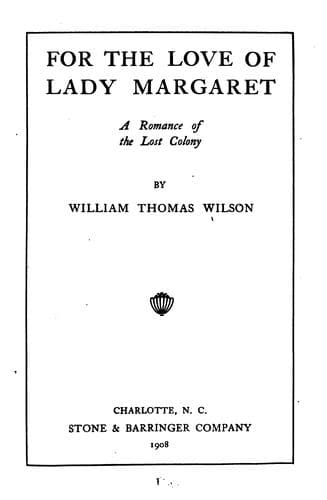
For the Love of Lady Margaret: A Romance of the Lost ColonyWilson, William Thomas
General
For the Love of Lady Margaret: A Romance of the Lost Colony
Wilson, William Thomas
Roanoke Colony -- Fiction
He spoke: "Show me some proof of that which thou sayest, Sir Thomas;
not that I doubt thy word, but this is a matter of importance that thou
talkest of, and not to be lightly decided."
"And of what advantage will this be to me?" I asked. "Why should I go
to the trouble, if it is to be of no benefit to me?"
He answered me, speaking slowly:
"It is of more importance than thou mayest think; thou art held here
by my power; did I but say the word thou shouldst go scot-free. Would
that be of advantage to thee? Could I think that the fat rogue played
me false, I would soon settle his fate. But why should he do that? It
would not be to his advantage, and he knows too well where his bread
lies to cut his own throat. His hopes are all based upon me; take me
away, and they fall to the ground. No, thou art mistaken, it could not
be so."
"Thou hast forgotten that Dunraven is rich and powerful; that he has
gold in abundance to reward his servants and tools. He wishes to keep
an eye upon thee, as well as myself. Perhaps he thinks that thou
mightst become a dangerous rival to him, or mightst be tempted to play
him false. What better spy could he choose on us both than Father
Francis?" I gazed at him, a smile of triumph upon my face.
He brought down his fist upon the table with a blow that made the
glasses ring.
"Show me the proof!" he cried--"but the proof, and then I shall know
how to act."
"Oliver," I said, turning to the boy, "go up into my room; move that
heavy chest which stands next the wall, and bring down to me the bundle
of papers that thou findest behind it."
He arose, and ran lightly from the room. I sat quietly in my seat, and
gazed at the Spaniard.
"What effect will this have upon my detention?" I asked. "Wilt thou
free me?"
"I shall know better how to answer when I see the papers," he replied
hoarsely.
The noise at the tables had redoubled. One of the seamen had brought
out a couple of flutes and was urging a short, squat sailor to give
them the sword dance. After much pressing by his friends, and after
drinking off a couple of glasses of wine, "only to steady his nerves a
bit," as he informed them, he announced that he was ready to begin.
A space was cleared in the middle of the room, and in it a dozen
swords were fastened, blades upward. The man had taken off his shoes,
and stood in his stocking feet, his eyes covered with a cloth.
The flute struck up a wild, barbarous air, and springing into the midst
of the swords he began to dance, while the men crowded eagerly around
him. Up he went, turning, twisting, whirling, all the while chanting a
low savage tune, now leaping to the right, now to the left, but always
alighting in the space, perhaps four inches in width, that lay between
each sword. Now advancing, now retreating, always evading the perilous
blades with a skill that was marvelous to me, when I thought of the
cloth over his eyes.
Public-domain text, read in full here on John Shaqi.
Reviews
Reviews
No reviews yet
Be the first to share your thoughts on this work.
Elsewhere in the archive
Join the Discussion
Join the discussion
Sign in to leave a comment or review.
Sign InorCreate an account