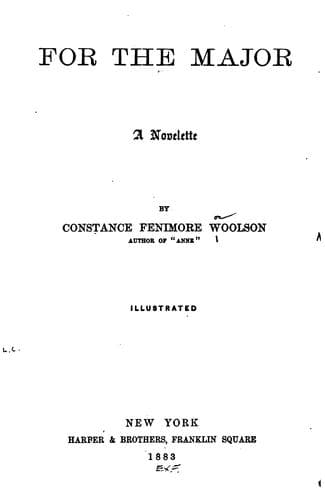
For the Major: A NoveletteWoolson, Constance Fenimore
General
For the Major: A Novelette
Woolson, Constance Fenimore
Psychological fiction; United States -- Social life and customs -- 19th century -- Fiction
Mr. Owen had started eastward on the day after his interview with the
two ladies of Carroll Farms; he had started westward on the day after
the arrival of a letter from his junior warden. This letter, written in
a clear, old-fashioned hand, decorated with much underscoring, was a
mixture of the formal phraseology of the warden's youth and that
too-modern lightness which he had learned in his later years, and of
which Miss Honoria so justly disapproved. He was supposed to be writing
about church business. Having finished that (in six lines), he added an
epitome of the news of the whole village, from the slippers which Miss
Sophy Greer, at the north end of Edgerley Street, was working for him
(the rector)--ecclesiastical borders, with the motto "Vestigia nulla
retrorsum"--down to the last new duck in the duck-pond at Chapultepec,
the south end of it. Among the items was this: "That amusing fellow
Dupont is, I am sorry to say, ill, and I suspect seriously. It is a
return of the fever he had in New York, I am told. He is at the Cove,
and the Walleys are taking care of him. It has leaked out" ("leaked
out"--oh, poor Miss Honoria!) "that he has no money, not even enough to
pay for his medicines--those musicians are always an improvident lot,
you know. But our lovely Madam Carroll, ministering angel that she is,
pitying lady of the manor, has supplied everything that has been
necessary. I have just heard, as I write these lines, that the poor
fellow is no better."
The rector, upon his return, busied himself in attending to the many
duties which had accumulated during his absence. He did not go to the
Farms immediately; but as he was making no calls for the present--owing
to the accumulation--the omission was not noticed. The musician was very
ill, and every one was sorry. His poverty was now generally known; but
Madam Carroll was doing all that was needful, and the poor wanderer
lacked nothing. That was what they called him now--the "poor wanderer;"
it was a delicate way of phrasing the fact that he was without means.
Far Edgerley people were as far as possible from being mercenary; they
had no intention of turning their backs upon Dupont because he was poor.
They were poor themselves, and, besides, that had never been the
Southern way. They would gladly have helped him now, had there been
opportunity, and they looked forward to helping him as far as they were
able so soon as he should have recovered his health. But at present
Madam Carroll was doing the whole, and the whole was only--could be
only--a doctor and medicines.
Public-domain text, read in full here on John Shaqi.
Reviews
Reviews
No reviews yet
Be the first to share your thoughts on this work.
Elsewhere in the archive
Join the Discussion
Join the discussion
Sign in to leave a comment or review.
Sign InorCreate an account