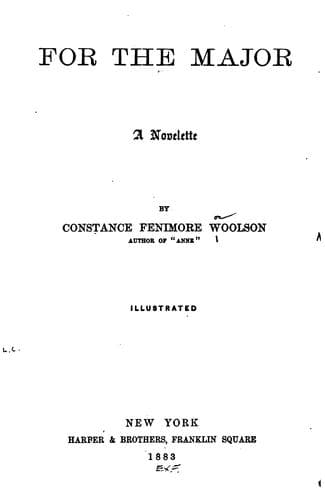
For the Major: A NoveletteWoolson, Constance Fenimore
General
For the Major: A Novelette
Woolson, Constance Fenimore
Psychological fiction; United States -- Social life and customs -- 19th century -- Fiction
"I prefer that you should know; and it is also a relief to me to tell,"
answered Madam Carroll, her eyes on the dark outline of the mountains,
visible in the moonlight through the open window. "My poor little
Cecilia passed easily for six, she was so small and frail, like Scar; in
reality she was over ten. The story was, you know, that I had been
married the first time at sixteen. That part was true; but nineteen
years had passed instead of seven, as they supposed. You are wondering,
probably, why I should have deceived your father in such little things,
matters unimportant. There had been no plan for deceiving him; it had
been begun before I met him; he simply believed what the others
believed. And later I found that they were not unimportant to him--those
little things; they were important. He thought a great deal of them. He
thought a great deal of my youth; youth and ignorance of the world,
child-like inexperience, had made up his ideal of me, and by the time I
found it out, his love and goodness, his dear protection, had become so
much to me that I could not run the risk of losing them by telling him
his mistake. I know now that I need not have feared this, I need not
have feared anything where he was concerned; but I did not know then,
and I was afraid. He saw in me a little blue-eyed, golden-haired
girl-mother, unacquainted with the dark side of life, trusting, sweet.
It was this very youth and childlike look which had attracted him, man
of the world as he was himself, and no longer young. I feared to shatter
his dream. In addition, that part did not seem to me of any especial
consequence; I knew that I should be able to live up to his ideal, to
maintain it not only fully, but longer, probably, than as though I had
been in reality the person he supposed me to be; for now it would be a
purpose, determinedly and carefully carried out, and not mere chance. I
knew that I could look the same for years longer; I have that kind of
diminutive prettiness which, with attention, does not change; and I
should give the greatest attention. I felt, too, that I should always be
entirely devoted to him. Gallant and handsome as he was, he was not
young, and I knew that I should care for him just the same through
illness, age, or infirmity; for I have that kind of faithfulness (many
women haven't) and--I loved him.
Public-domain text, read in full here on John Shaqi.
Reviews
Reviews
No reviews yet
Be the first to share your thoughts on this work.
Elsewhere in the archive
Join the Discussion
Join the discussion
Sign in to leave a comment or review.
Sign InorCreate an account