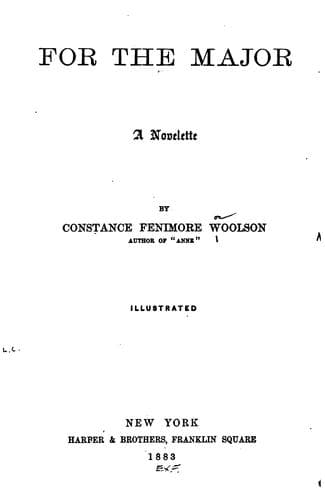
For the Major: A NoveletteWoolson, Constance Fenimore
General
For the Major: A Novelette
Woolson, Constance Fenimore
Psychological fiction; United States -- Social life and customs -- 19th century -- Fiction
"We cannot. Yet we do," answered Madam Carroll. "I know it; I am sure of
it." She was silent for a moment; then went on speaking softly in the
darkness, as if half to herself. "His poor clothes, Sara--oh, so
neglected and worn!--I could not bear it when I saw them. I had asked
him about them more than once, and he always said that they were in good
order--that is, good enough. But I pressed him; I wanted to see with my
own eyes; and at last I succeeded in persuading him to bring a few of
them late in the evening when no one would see him, and put them under
the hedge near the gate; then, when everybody was asleep, I stole down
to get them, took them into the sitting-room, lighted the lamp, and
looked at them. In 'good order' he had called them, poor boy, when they
were almost rags. I cried over those clothes, Sara; I could not help it;
they were the only tears I shed. It showed so plainly what his life had
been. I could not help remembering in what careful order were all his
little frocks and jackets when he was my dear little child. After that I
made him bring me a few things once a week. I gave him a little old
carpet-bag of mine to put them in. I used to mend them in my
dressing-room, with the door locked, whenever I had a little leisure (I
took only my leisure), and then I carried them down and put them under
the hedge when I knew he was coming. It was a comfort to me to do it;
but he didn't care anything about the mending himself--he said so. He
had lived so long with his poor things neglected and ragged that he
didn't know any other way. Yet he tried, too, after his fashion--a man's
fashion--to dress well. Don't you remember his red silk handkerchiefs
and socks, and his silk-lined umbrella? Poor boy, he had the wish; but
not the money or the knowledge. How could he learn, living where and as
he had? That watch-chain and ring he had when he came back--they were
only gilt."
The grieving story was no longer uttered aloud, the low tones ceased.
But the mother was pursuing the train of thought in her own mind.
After a while she spoke again. "I was so unwilling to tell you, Sara, to
burden you with it all! Nothing could have made me do it but the fear
of--of that which afterwards _did_ happen--death. For when he came back
after that illness, and I saw how changed he was, how weak, and knew
that I had nothing to help him with, then I felt desperate. I knew that
he ought to return to that warmer climate, and at once; I had nothing of
my own, and the Major's money, of course, I would not take. Yours is not
his, and so I came to you; I knew that you would help me to the utmost
of your power--as you have. But if there had been any possible
alternative, anything else in the world that I could have done--and I
thought over everything--I want you to believe that I should never have
come to you."
"It was too much for you to bear alone, mamma."
Public-domain text, read in full here on John Shaqi.
Reviews
Reviews
No reviews yet
Be the first to share your thoughts on this work.
Elsewhere in the archive
Join the Discussion
Join the discussion
Sign in to leave a comment or review.
Sign InorCreate an account