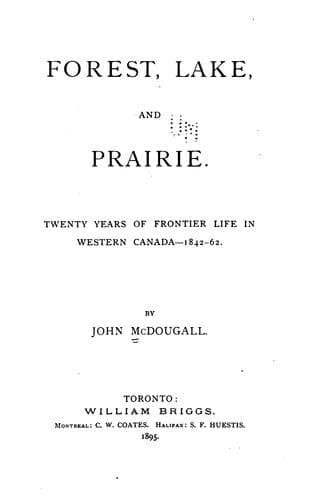
Forest, Lake and Prairie: Twenty Years of Frontier Life in Western Canada—1842-62McDougall, John
History
Forest, Lake and Prairie: Twenty Years of Frontier Life in Western Canada—1842-62
McDougall, John
Frontier and pioneer life -- Northwest, Canadian; McDougall, John, 1842-1917; Northwest, Canadian -- Description and travel
Edmonton then consisted of the Hudson's Bay Company's fort, and this
was all in the vicinity. Out north, about nine miles distant, was a
newly commenced Roman Catholic mission; but here the four walls of
the fort enclosed everything. Stores and dwelling-houses were packed
in a small space, and when the trip-men and voyageurs were home for
the winter the post would be crowded.
I had now seen three Hudson's Bay Company's forts in the
Saskatchewan--Carlton, Pitt, and Edmonton--all situate in one of the
richest agricultural districts in Canada, but each and all striking
evidence that the Hudson's Bay Company was nothing more than a
fur-trading organization; they were not settlers nor farmers. Pelts
and not bread, furs and not homes, were what they aimed at.
Though only a boy, I could readily see that before many years this
would be changed, for no power under heaven could keep settlement out
of this country I had already been privileged with seeing a portion
of.
CHAPTER XXXVII.
Start for new home--Miss seeing father--Am very lonely--Join Mr.
Woolsey.
Father was now at his objective point in the west, and as the season
was advanced he must make haste to return to Norway House.
His plan was to go down the river in a skiff. I was to remain with
Mr. Woolsey as a sort of assistant and interpreter.
Our present plan was for Mr. Woolsey to accompany father in the skiff
to where we had crossed the river on our southward journey some weeks
since, and Peter and I were to take the horses down on the north side
to meet them at this point.
William had gone on to Smoking Lake and would meet us there.
We were to leave Edmonton the same day, and hoped to reach our
rendezvous about the same time; but Peter and I had quite a bunch of
horses to drive, and most of the road was dense forest, with the path
narrow and almost overgrown with timber. Our horses, too, would run
off into the thicket, so that when we came to an open space beyond,
and counted up, we would generally find some were missing. While I
guarded those we had, Peter would go back and patiently track up the
rest. Thus, instead of reaching the spot where we were to meet
father and party the second evening, it was long after dark on the
third evening when we came there.
I had not seen father to say "Good-bye," at Edmonton, and I had many
things to say to him before we parted for the year, and now I
expected to meet him camped on the banks of the river, but as we rode
down the hill into the valley all was darkness. There could be no
mistake; this was the spot, but no camp and no sign of father. We
wondered what was up; presently I saw something white, and, riding to
it, found a note stuck in the end of a small pole, and we lit a match
and I read:
"My DEAR BOY,--
"We came here early to-day and waited some hours, but the season
urges me on. Am sorry to miss meeting you. Play the man. Do your
best to help Mr. Woolsey.
"God bless you, my son. Good-bye.
Public-domain text, read in full here on John Shaqi.
Reviews
Reviews
No reviews yet
Be the first to share your thoughts on this work.
Elsewhere in the archive
Join the Discussion
Join the discussion
Sign in to leave a comment or review.
Sign InorCreate an account