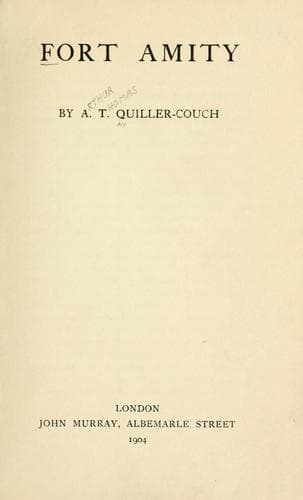
United States -- History -- French and Indian War, 1754-1763 -- Fiction
He did not hear Menehwehna's voice lamenting the broken pipe.
He stood staring across at the fort. He saw the river-gate open, the
red-coats moving there, relieving guard. He saw the flagstaff
halliards shake out the red cross of England in the morning sunlight.
And still, like a river, rolled the music of British drums.
"Netawis!"
Menehwehna touched his arm. At first John did not seem to hear, then
his hand went up and began to unfasten the silver armlets there.
"Netawis! O my brother!"
But the ice had slipped from the rock and lay around its base in
ruin, and the music which had loosened it still sang across the
valley. He took a step down the slope towards it.
"You shall not go!" cried Menehwehna, and lifting his gun pointed it
full at John's back. And John knew that Menehwehna's finger was on
the trigger. He walked on unregarding.
But Menehwehna did not fire. He cast down his gun with a cry and ran
to clasp his friend's feet. What was he saying? Something about
"two years."
"Two years?" Had they passed so quickly? God! how long the minutes
were now! He must win across before the drums ceased . . .
He halted and began to talk to Menehwehna very patiently, this being
the easiest way to get rid of him. "Yes, yes," he heard himself
saying, "I go to them as an Indian and they will not know me.
I shall be safe. Return now back to my brothers and tell them that,
if need be, they will find me there and I will speak for them."
And his words must have prevailed, for he stood by the river's edge
alone, and Menehwehna was striding back towards the wood. A boat lay
chained by the farther shore and two soldiers came down from the fort
and pushed across to him.
They wore the uniform of the Forty-sixth, and one had been a private
in his company; but they did not recognise him. And he spoke to them
in the Ojibway speech, which they could not understand.
From the edge of the woods Menehwehna watched the three as they
landed. They climbed the slope and passed into the fort.
CHAPTER XXI.
FORT AMITIE LEARNS ITS FATE.
That Spring, three British generals sat at the three gates of Canada,
waiting for the signal to enter and end the last agony of New France.
But the snows melted, the days lengthened, and still the signal did
not come; for the general by the sea gate was himself besieged.
Through the winter he and his small army sat patiently in the city
they had ruined. Conquerors in lands more southerly may bury their
dead with speed, rebuild captured walls, set up a pillar and statue
of Victory, and in a month or two, the green grass helping them,
forget all but the glory of the battle. But here in the north the
same hand arrests them and for six months petrifies the memorials of
their rage. Until the Spring dissolves it, the image of war lives
face to face with them, white, with frozen eyes, sparing them only
the colour of its wounds.
Public-domain text, read in full here on John Shaqi.
Reviews
Reviews
No reviews yet
Be the first to share your thoughts on this work.
Elsewhere in the archive
Join the Discussion
Join the discussion
Sign in to leave a comment or review.
Sign InorCreate an account