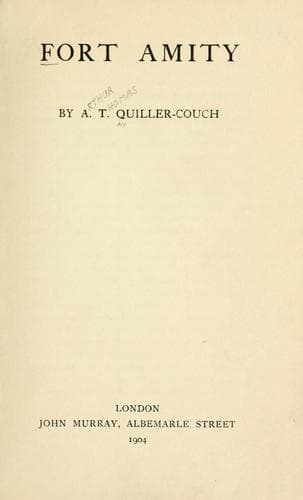
United States -- History -- French and Indian War, 1754-1763 -- Fiction
The mischief was, he could not be gainsaid. Major Etherington
explained--at first in English, to his General, and again, at his
General's request, in the best French he could command, for the
benefit of all, that he had indeed heard the recall blown, and had
with difficulty drawn off his men from the scaling-ladders,
persuading them (as he himself was persuaded) that the fort had
surrendered. He knew nothing of the white flag at the gateway, but
had formed his conclusions from the bugle-calls and the bare
flagstaff above the tower.
"Nevertheless, we had not capitulated," persisted M. Etienne.
The Major continued that, albeit he had tried his best, the Indians
were not to be restrained. They had poured into the fort, and,
although he had obeyed the bugles and kept his men back, it had cost
him grave misgivings. But when the Ojibway called down so urgently
from the summit of the tower, he had risked disobedience, hoping to
prevent the massacre which he knew to be afoot. He appealed to his
General to approve, or at least condone, this breach of orders.
For undoubtedly massacre had been prevented. Witness the crowd he
had found jammed in the stairway, and fighting ferociously.
Witness the scene that had met him at the head of the stairs.
Here he swung round upon John and beckoned him to stand out from the
listening group of red-coats.
"It can be proved, sir," he went on, addressing M. Etienne, "that the
lady--your niece, is she not?--owes her life, and more than her life
perhaps, to this savage. I claim only that, answering his call, I
led my men with all possible speed to the rescue. Up there on the
leads I found your brother lying dead, with a sergeant dead beside
him; and their wounds again will prove to you that they had perished
by the bursting of a shell. But this man alone stood on the hatchway
and held it against a dozen Iroquois, as your niece will testify.
What you suppose yourself to owe him, I won't pretend to say; but I
tell you--and I tell you, General--that cleaner pluck I never saw in
my life."
John, the soldiers pushing him forward, stood out with bent head.
He prayed that there might be no Ojibway interpreter at hand; he knew
of none in the fort but Father Launoy, now busy in the chapel laying
out the Commandant's body. Of all the spectators there was but one--
the General himself--who had not known him either as Ensign John a
Cleeve or as the wounded sergeant from Ticonderoga. He had met
Captain Muspratt at Albany, and remembered him well on the march up
the Hudson to Lake George. With Major Etherington he had marched,
messed, played at cards, and lived in close comradeship for months
together--only two years ago! It was not before their eyes that he
hung his head, but before the thought of two eyes that in the chapel
yonder were covered by the hands of a kneeling girl.
M. Etienne stepped forward and took his hand.
"I thank you, my friend--if you can understand my thanks."
Public-domain text, read in full here on John Shaqi.
Reviews
Reviews
No reviews yet
Be the first to share your thoughts on this work.
Elsewhere in the archive
Join the Discussion
Join the discussion
Sign in to leave a comment or review.
Sign InorCreate an account